
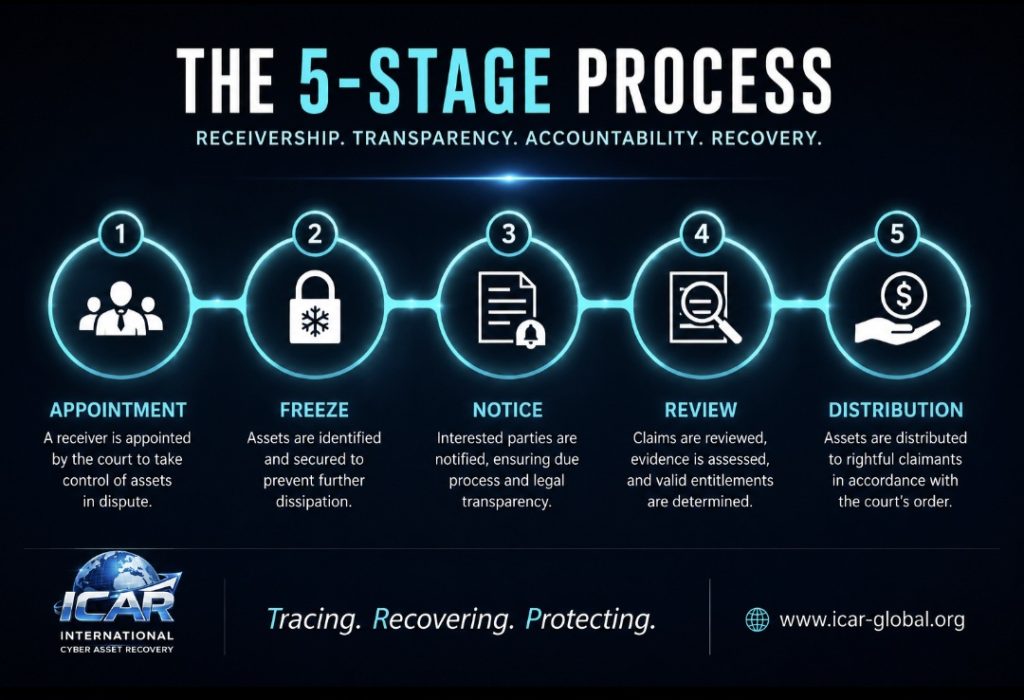
The receivership claims process is the court-supervised system that distributes whatever assets remain after a Ponzi scheme collapses, and it typically unfolds in five stages: receiver appointment, asset freeze and investigation, a formal claims notice with a hard filing deadline called a bar date, claims review (including any clawback determinations), and finally court-approved distribution. This guide walks through each stage in the order it actually happens, using a real 2025 case to make the process concrete, plus a tax detail many victims never learn about until it’s too late to use. (This is a companion piece to our Hub article, Ponzi Schemes & High-Yield Investment Fraud Explained, and our Pillar guide, Investment Scams — The Complete Guide.)
| 2 Deadlines
Real receiverships often set separate bar dates for individual claimants and government claimants — missing either one can mean forfeiting your claim entirely Source: SEC v. Legend Venture Partners receivership claims procedures, 2025 |
Stage 1: The Receiver Is Appointed
When the SEC or another regulator files an enforcement action against a suspected Ponzi scheme, the court overseeing the case typically appoints a receiver (usually an experienced attorney or forensic accountant) to take immediate control of the entity’s assets, records, and operations. This appointment happens quickly, often within days of the initial complaint, specifically to prevent further dissipation of remaining funds while the case proceeds. From this point forward, the receiver, not the original operators, controls what happens to any remaining money.
Stage 2: Asset Freeze and Investigation
The receiver’s first job is to locate everything that can be recovered: bank accounts, real estate, vehicles, cryptocurrency, and any other assets connected to the scheme, sometimes across multiple states or countries. This stage can take months on its own, particularly when funds were moved through shell companies, offshore accounts, or crypto wallets designed specifically to obscure their trail. The receiver typically also investigates the full scope of the fraud (how many investors, how much was raised, and how funds actually moved) to build the factual record the rest of the process depends on.

Stage 3: The Claims Notice and Bar Date
Once the receiver has enough of a picture to proceed, the court approves a formal claims process, and notice goes out to known investors and other creditors. This notice sets a bar date, a hard deadline by which every claimant must submit a proof of claim form with documentation of their investment. Missing this deadline can mean forfeiting your entire share of whatever gets distributed, even if you’re a completely legitimate victim, which makes it one of the single most consequential dates in the entire process.
A real 2025 case illustrates how this actually works in practice. In the SEC’s case against Legend Venture Partners, the court-appointed receiver’s approved claims procedures set two separate bar dates: one for non-governmental claimants and a later one for government claimants, each with a specific deadline time on a specific date. The notice also specified precisely who qualified as a “claimant” under the process, including anyone owed money for goods or services, loans, taxes, or other legal claims, while clarifying that investors holding an ownership interest in the entity itself would have their positions handled through separate investor statements rather than a proof-of-claim filing. This distinction between different claimant categories is common and worth reading carefully in the specific notice you receive, since the correct filing path differs depending on which category you fall into.
Stage 4: Claims Review and Net Winner/Net Loser Determination
Once the bar date passes, the receiver reviews every submitted claim against the entity’s own records (bank statements, account records, and transaction histories) to verify the amounts claimed. This is also the stage where the receiver determines each investor’s status as either a “net loser” (someone who deposited more than they ever withdrew) or a “net winner” (someone who withdrew more than they deposited, meaning some of what they received was actually other victims’ money paid out as fake profit).
Net winners can face a clawback claim requiring them to return some or all of their withdrawn “profit” back into the common pool for fair distribution among all victims, a mechanic we cover in more depth in our Ponzi/HYIP Hub article. This determination process can itself take considerable time, particularly in larger schemes with thousands of claimants and years of transaction history to reconstruct.
Stage 5: Court Approval and Distribution
Once claims are reviewed and any disputes resolved, the receiver proposes a distribution plan to the court, typically calculating each net-loser claimant’s share on a pro-rata basis, meaning proportional to their net loss relative to the total pool of recoverable assets and total net losses across all claimants. The court must approve this plan before any funds are actually distributed, and objections from claimants are typically heard during this stage. Distribution itself often happens in more than one round, as additional assets are recovered or litigation against third parties concludes over time.
How Long Does This Actually Take?
There’s no fixed timeline, and it varies enormously based on the scheme’s size, how many jurisdictions and asset types are involved, and whether litigation against third parties (banks, accountants, or others who may have facilitated the fraud) is part of the recovery effort. Smaller, more contained schemes can sometimes reach a first distribution within a year or two of the receiver’s appointment. Larger, more complex ones, particularly those involving international assets or extensive litigation, can take considerably longer, sometimes many years, before victims see any distribution at all.
The Tax Detail Most Victims Never Learn About
This is worth its own section because so few victims learn about it in time to use it well. Losses from a Ponzi scheme can often be deducted as a theft loss under IRC §165, which — unlike an ordinary investment capital loss — isn’t capped at the usual $3,000 annual limit that applies to capital losses. The IRS created a specific safe harbor under Revenue Procedure 2009-20 that simplifies this significantly for qualifying victims, generally allowing a deduction of 95% of the qualified investment (or 75% if pursuing a separate third-party recovery claim) without needing to prove every element of theft under general tax rules, which can otherwise be a genuinely difficult factual burden.
The safe harbor’s “year of discovery” , the tax year in which the loss becomes deductible is generally tied to a specific triggering event, such as the scheme’s lead figure being criminally indicted or the subject of a state or federal criminal complaint. This is a meaningfully technical area of tax law, and the specific facts of a case (including whether there’s still a “reasonable prospect of recovery” through the receivership process itself) can affect eligibility and timing. This is worth raising with a tax professional specifically familiar with Ponzi scheme losses, ideally well before a tax filing deadline rather than after, since the theft-loss deduction can meaningfully offset what would otherwise be a purely uncompensated loss.
What To Do While You Wait
- Confirm you’re on the receiver’s mailing/notice list — if you invested but never received a claims notice, contact the receiver’s office directly rather than assuming you’ll be found automatically.
- Gather your documentation now: account statements, deposit and withdrawal records, and any communications with the scheme’s operators, don’t wait for the bar date to start assembling this.
- Mark the bar date clearly and file well before the deadline, not on the day itself, in case of any submission issues.
- Consult a tax professional about the theft loss deduction well before your filing deadline, not after.
- If your case involves cryptocurrency or assets the receiver’s search may not have fully captured, a professional case assessment can help identify recovery paths that run alongside, not against, the official receivership process.
Frequently Asked Questions
What happens if I miss the bar date?
You can potentially forfeit your entire claim to any distribution, even as a legitimate victim, this is one of the most consequential deadlines in the entire process, so mark it clearly and file well in advance.
How much will I actually get back?
It varies enormously by case, distribution is calculated pro-rata based on total recovered assets relative to total net losses across all claimants, and full recovery is uncommon since a meaningful share of funds is often gone by the time a scheme is discovered.
What if I’m found to be a ‘net winner’?
You may face a clawback claim requiring you to return some or all of what you withdrew above your original deposits, since that amount was, in reality, other victims’ money paid out as fake profit rather than real investment return.
Can I really deduct my losses on my taxes?
Often yes, as a theft loss under IRC §165, potentially using the simplified safe harbor under Revenue Procedure 2009-20 — but eligibility and timing depend on specific facts, so consult a tax professional familiar with Ponzi scheme losses.
Should I hire my own attorney, or just rely on the receiver?
The receiver represents the collective interests of all victims, not any one individual claimant — for a large claim or a complicated situation, independent legal or investigative advice can be worthwhile alongside the official process, not instead of it.
Related Reading
→ Parent Hub: Ponzi Schemes & High-Yield Investment Fraud Explained
→ Pillar guide: Investment Scams — The Complete Guide
→ Free Case Assessment: Complete case form or contact support via WhatsApp