

A Ponzi scheme is a fraud that pays returns to earlier investors using the deposits of later investors, rather than from any genuine profit, a structure that always collapses once new money slows down. In its fiscal year 2025 enforcement results, published April 2026, the US Securities and Exchange Commission reported pursuing multiple large-scale Ponzi and high-yield investment schemes, including one that raised over $770 million from roughly 2,700 investors and caused $400 million in losses, and another that took more than $140 million from around 300 investors. This article breaks down how Ponzi schemes and their modern cousin, the high-yield investment program (HYIP), actually work: the math that should raise a flag before you ever invest, how affinity fraud turns community trust into a weapon, and what happens legally once a scheme collapses.
| $17.9B
Total monetary relief the SEC ordered in FY2025 across its enforcement actions — a record year, driven substantially by Ponzi and offering-fraud cases Source: US Securities and Exchange Commission, FY2025 Enforcement Results, April 2026 |
The Anatomy of a Ponzi Scheme
Named after Charles Ponzi’s 1920s postal-coupon scheme and made infamous at scale by Bernie Madoff, the structure hasn’t changed in a century: money from new investors pays the “returns” promised to earlier ones, with little or no legitimate underlying business generating real profit. The scheme can run for months or years, Madoff’s ran for decades, as long as enough new money keeps entering. It collapses the moment withdrawals outpace new deposits, redemptions are frozen, or a regulator intervenes.
What makes a Ponzi scheme durable, sometimes for years at a time, is that it doesn’t need every investor to believe in it forever, it only needs enough new deposits each month to cover that month’s redemption requests. Madoff’s scheme survived for an estimated two decades partly because it deliberately avoided the explosive, too-good-to-be-true returns of a typical HYIP, instead paying steady, unspectacular, believable numbers that never triggered obvious suspicion. That’s an important lesson on its own: a scheme doesn’t have to look flashy to be fraudulent. Slow, steady, and just slightly better than the market is sometimes the more dangerous version, precisely because it’s designed to avoid scrutiny.
A high-yield investment program, or HYIP, is functionally the same fraud dressed in more modern language, typically an online platform promising fixed daily, weekly, or monthly returns from a vague strategy like forex trading, arbitrage, or “AI-powered” trading algorithms. HYIPs are especially common in crypto-adjacent spaces because cross-border crypto payments make both collecting deposits and disappearing with them faster.
Both structures depend entirely on a mismatch investors rarely think to check: the promised return has no connection to any actual, verifiable trading activity. In a legitimate fund, you can typically request audited financials, a custodian statement from an independent bank or brokerage holding the actual assets, and a registered adviser’s Form ADV filing. In a Ponzi or HYIP scheme, at least one of those pieces is always missing, vague, or unverifiable; the fund administrator, the custodian, and the auditor are frequently one and the same entity, or don’t exist as independently checkable parties at all.
Case Study Walkthrough: How the Heller/Prestige Scheme Actually Ran
The SEC’s largest FY2025 Ponzi action is worth walking through in detail because the pattern is instructive well beyond this one case. According to the SEC’s complaint, Daryl Heller and his companies Prestige Investment Group and Paramount Management Group raised more than $770 million from approximately 2,700 investors between January 2017 and June 2024, telling investors their money would fund a network of ATMs that Paramount operated, with returns paid from ATM transaction fees.
The pitch had surface-level plausibility that made it harder for investors to dismiss: ATMs are a real, understandable business, and a modest return from transaction fees sounds far more believable than a vague crypto trading algorithm. That plausibility is exactly what made it effective for seven years. What investors couldn’t easily verify was whether the actual number of ATMs, and their actual transaction volume, could ever have generated anything close to the returns being paid and, per the SEC’s complaint, it could not. The company allegedly used new investor funds to pay earlier investors’ returns, the defining Ponzi mechanic, for years before the scheme was charged.
The takeaway for evaluating any investment pitch: a plausible-sounding underlying business is not the same as a verified one. If an opportunity is built around a real-world business: ATMs, real estate, a restaurant chain, equipment leasing, ask specifically how many units/properties/assets currently exist, request independently verifiable documentation (public records, satellite imagery, an on-site visit), and compare the stated revenue per unit against public industry benchmarks. A gap between the story and the checkable numbers is the same red flag whether the vehicle is crypto or vending machines.
Warning Signs in the Marketing Materials Themselves
Beyond the return itself, the way an opportunity is marketed often contains its own tells. Legitimate investment offerings are required to disclose specific risks, fees, and conflicts of interest in writing, disclosures that are often dense and unglamorous precisely because they’re legally mandated, not optional marketing copy. Fraudulent offerings tend to read the opposite way: heavy on lifestyle imagery and testimonials, light on risk disclosure, and vague about exactly which regulator, if any, oversees the offering.
- Marketing that emphasizes exclusivity or scarcity (“only accepting 50 more investors”) to discourage careful due diligence
- Testimonials and “as seen in” media logos that can’t be verified through the original source
- A registered agent or business address that resolves to a virtual office or mail-forwarding service
- An offering that isn’t registered with the SEC or your national regulator, or that claims an exemption without explaining which one
- A principal who deflects specific due-diligence questions with reassurance (“trust me, I’ve never had an unhappy investor”) rather than documentation
Verifying an Adviser or Offering Before You Invest
Every US-registered investment adviser has a Form ADV on file with the SEC, searchable free through the Investment Adviser Public Disclosure database: it discloses disciplinary history, fee structure, and the firm’s actual assets under management, which can be cross-checked against what you’re being told. The UK’s FCA, Australia’s ASIC, Canada’s CSA, Singapore’s MAS, and Hong Kong’s SFC all maintain equivalent public registers. Checking a registration number takes minutes and is one of the highest-leverage due-diligence steps available to any investor, at any investment size, and it’s precisely the step most Ponzi and HYIP victims skip, because the personal referral or community trust that brought them the opportunity already felt like sufficient verification.
2025’s Record Enforcement Year
The scale of last year’s enforcement activity is itself instructive about how common these schemes have become. The SEC’s Daryl Heller case alone — trading under Prestige Investment Group and Paramount Management Group — allegedly raised $770 million from about 2,700 investors between 2017 and 2024, promising returns from an ATM-operation investment that regulators say never generated anything close to what was paid out, resulting in an estimated $400 million in losses.
In a separate action, First Liberty Building & Loan and its owner Edwin Brant Frost IV were charged over an alleged scheme that took more than $140 million from roughly 300 investors. Nightingale Properties and its founder were charged with raising $60 million from about 700 retail investors through false representations, misappropriating more than $52 million. And in North Texas, the SEC charged Arsalan Rawjani with running an affinity fraud and Ponzi scheme inside the local Ismaili community, where he held himself out as an options-trading expert and promised guaranteed monthly dividends of three to five percent, a fixed, guaranteed return that is itself a hallmark of fraud, since no legitimate trading strategy can promise a fixed monthly return regardless of market conditions.
Across FY2025, the SEC reported total monetary relief of $17.9 billion, though the Commission itself noted that figure is heavily weighted by a single long-running case, the $8 billion Robert Allen Stanford Ponzi scheme judgment, first brought in 2009, illustrating how long these cases can take to resolve even after a scheme is shut down.
High-Yield Investment Programs: The Crypto-Era Update
Where classic Ponzi schemes relied on paper statements and in-person trust, HYIPs operate almost entirely online, often advertising through social media, Telegram groups, or paid search ads. They typically promise a specific, fixed daily or weekly percentage return, sometimes framed as “1% a day” or similar, which sounds modest but compounds to an obviously impossible annualized return once you do the math. Payouts to early investors, often processed automatically to build credibility, are funded entirely by new deposits, and the site or app disappears once new money slows, exactly as a traditional Ponzi scheme would.
Affinity Fraud: When the Trust Is the Weapon
Affinity fraud specifically targets members of an identifiable group: a religious congregation, an ethnic or professional community, a military or veteran network, where the fraudster is often a trusted member of that same community. The Ayasa case illustrates the pattern precisely: the organizer was an active, visible member of the North Texas Ismaili community he later defrauded, using that standing to lend credibility to guaranteed-return claims that would have drawn more scrutiny from a stranger.
What makes affinity fraud especially damaging is the social dynamic it exploits. Victims are less likely to conduct independent due diligence on someone vouched for by their own community, and existing investors often unknowingly recruit friends and family, extending the fraud’s reach through trusted relationships rather than cold outreach. The SEC has specifically flagged veterans, seniors, and religious communities as disproportionately targeted in its FY2025 enforcement priorities.
Affinity fraud also tends to suppress early reporting even after suspicion sets in. Victims frequently describe hesitating to raise concerns publicly because doing so means questioning a respected community figure, risking social standing, or being the one who “caused a panic” that hurts others still invested. That hesitation buys the scheme additional runway, every week of silence is another week of new deposits propping up the structure. If you’re in a group where an investment is being widely recommended by a trusted member, asking a direct, specific due-diligence question publicly is not a betrayal of the community; it’s often the single action that protects it.
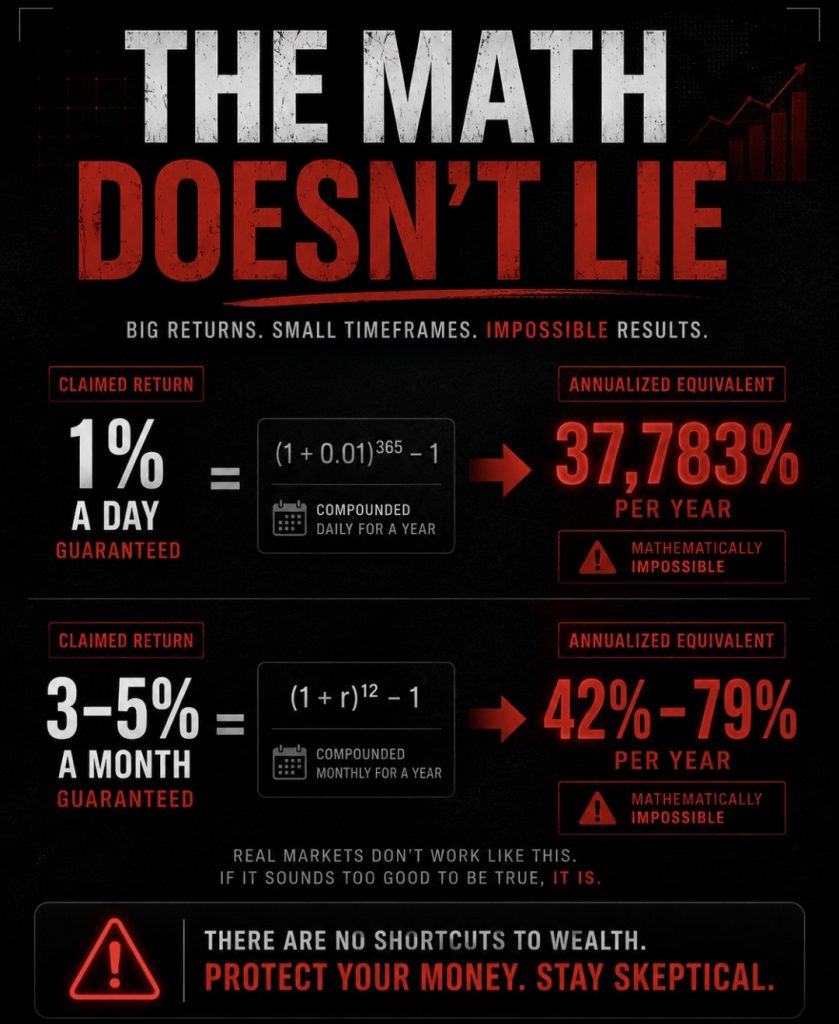
The Math That Should Always Raise a Flag
Every legitimate investment carries risk, which means returns fluctuate, sometimes significantly with market conditions. A guaranteed fixed return, especially one paid on a rigid daily, weekly, or monthly schedule regardless of what markets are doing, is not a feature of a strong investment; it is close to a mathematical impossibility for any legitimate strategy operating at scale. A promised return of even 1% per day compounds to a number no real market has ever sustained. A guaranteed 3-5% per month, as in the Ayasa case, implies 36-60%+ annualized — territory that only fraud, not skill, reliably delivers.
A useful gut-check: if a stranger, or a fellow congregant, colleague, or veteran offers you a fixed, guaranteed return meaningfully above what a savings account or index fund would pay, ask what specifically generates that return, and verify the answer independently rather than taking their word or their track record of “paying everyone so far” as proof. Every Ponzi scheme pays everyone, right up until it doesn’t.
Red Flags of a Ponzi or HYIP Scheme
- A fixed, guaranteed return regardless of market conditions
- Consistent, unusually smooth returns with no losing periods
- Vague or evasive explanations of the underlying strategy
- Pressure to recruit others, sometimes with a referral bonus structure
- Difficulty getting complete documentation, or unregistered securities
- An organizer positioned as a trusted, prominent member of your own community

What Happens After a Ponzi Scheme Collapses: Receivership & Clawbacks
Once a Ponzi scheme is shut down typically by SEC action, a criminal indictment, or the scheme simply running out of new money, a court usually appoints a receiver to take control of remaining assets on behalf of all victims collectively, rather than allowing a first-come, first-served scramble. The receiver’s job is to locate and liquidate whatever assets remain, then distribute proceeds proportionally among victims through a formal claims process.
One of the more difficult realities victims should understand upfront: investors who withdrew more than they originally deposited, meaning they received “profit” that was, in reality, other victims’ money, can be subject to a clawback claim from the receiver, requiring them to return those funds to the common pool for fair distribution. This is not a punishment; it reflects that the “profit” was never real, only a transfer from later victims. Anyone who invested in a scheme now under receivership should expect to receive formal notice of the claims process and should respond to it promptly and completely.
The claims process itself typically unfolds in stages: the receiver first works to identify and freeze remaining assets, which can include bank accounts, real estate, vehicles, and cryptocurrency, sometimes located in jurisdictions far from where investors reside. A claims bar date is then set: a hard deadline by which every victim must submit documentation of their investment to be considered for distribution. Missing that date can mean forfeiting any share of recovered funds entirely, which is why responding to receiver correspondence quickly, even before you’ve fully processed what’s happened, matters more than almost any other single action available to a victim at this stage. Distribution itself, once approved by the court, is usually calculated on a pro-rata basis reflecting net losses, original deposits minus any amounts already withdrawn, rather than a flat per-investor amount, and can take anywhere from months to several years depending on how many jurisdictions and asset types the receiver has to untangle.
What To Do If You’re Caught in a Collapsing Scheme
- Stop making further deposits immediately, even if the organizer pressures you to “double down” to recoup losses.
- Gather every document: account statements, marketing materials, communications, and proof of every deposit and withdrawal.
- Report to the SEC (US), the FCA (UK), or your national securities regulator, even before a formal receivership is announced.
- Watch for official receiver communications and respond to any claims-process notice by its deadline.
- Be wary of unsolicited “recovery” services contacting known victim lists, this is a common secondary scam.
- Get a professional case assessment, particularly if any funds moved through cryptocurrency at any stage.

How ICAR Helps
Ponzi and HYIP cases often involve funds that moved across multiple accounts, shell entities, or cryptocurrency before a scheme collapsed. ICAR’s investigators support victims through this process by tracing fund movement, documenting the paper trail needed for receivership claims, and identifying assets that a formal receiver’s search may not have captured, particularly where cryptocurrency was used to move or hide funds ahead of a collapse.
This work often runs in parallel with, rather than instead of, the official receivership process. A court-appointed receiver is working on behalf of all victims collectively and typically has limited resources relative to the scope of a large scheme, particularly when assets moved offshore or into cryptocurrency shortly before collapse. Independent investigative work — OSINT research into where a scheme’s principals moved money personally, blockchain tracing of any crypto-denominated transfers, and wallet clustering to map related accounts — can surface assets or leads that strengthen an individual claim or support a broader recovery effort alongside the formal process, rather than competing with it.
How to Report Investment Fraud, by Region
- UK — the Financial Conduct Authority’s Warning List and Report Fraud
- US — the Securities and Exchange Commission (SEC) and the FBI’s IC3
- Canada — the Canadian Securities Administrators and the CAFC
- Australia — ASIC and Scamwatch
- Singapore — the Monetary Authority of Singapore and the SPF Anti-Scam Centre
- Hong Kong — the Securities and Futures Commission and the ADCC
Frequently Asked Questions
What’s the difference between a Ponzi scheme and a pyramid scheme?
A Ponzi scheme is typically run by one central operator who directly manages all funds and payouts. A pyramid scheme relies on participants actively recruiting others, with commissions structured around recruitment rather than any product or investment.
What’s the difference between a Ponzi scheme and an HYIP?
They’re the same underlying fraud — an HYIP is simply the modern, typically online and crypto-adjacent version, usually advertising a specific fixed daily or weekly return rather than a vaguer promise.
What is affinity fraud, specifically?
Fraud that specifically targets members of an identifiable community: religious, ethnic, professional, or military, often carried out by someone trusted within that same community, which reduces the scrutiny victims apply.
If I received payouts before the scheme collapsed, can I be forced to return them?
Potentially, yes — a court-appointed receiver can pursue a “clawback” of profits paid to earlier investors, since those payouts came from other victims’ deposits rather than real returns.
How does the receivership claims process actually work?
A court-appointed receiver takes control of remaining assets, then distributes proceeds proportionally among all victims who file a valid claim by the court-set deadline — watch for official notices and respond promptly.
What return percentage should make me suspicious?
Any fixed, guaranteed return meaningfully above ordinary market returns — particularly one paid on a rigid schedule regardless of market conditions — warrants independent verification before investing further, regardless of how consistently it’s been paid so far.
Can I recover money lost in a Ponzi scheme?
Partial recovery is common through the receivership process, though rarely 100% of losses, since much of the money is typically gone by the time a scheme is discovered. Acting quickly and filing claims properly meaningfully affects individual outcomes.
If You’ve Been Caught in a Collapsing Scheme, You’re Not Alone
Ponzi and high-yield investment fraud succeed by making a guaranteed return feel safe sometimes because a trusted friend recommended it, sometimes because everyone else in the room seemed to believe it too. If you’re navigating a collapsed scheme or a receivership claims process, ICAR’s investigators can help trace funds and build the documentation your claim needs.
It’s worth saying plainly: the shame that keeps victims quiet is precisely what allows these schemes to run as long as they do. Every case we’ve referenced here — the ATM network, the church community fund, the property portfolio — persisted for years not because the fraud was undetectable, but because the social and financial cost of speaking up felt higher than staying quiet, right up until the collapse made silence impossible anyway. Raising a concern early, even a tentative one, is never the wrong call, and it never makes you responsible for a fraud someone else designed.
→ Read our Crypto Investment Scams deep dive: blog/crypto-investment-scams
→ Read our Pig Butchering Scams deep dive: blog/pig-butchering-scams
→ Free Case Assessment: free-case-assessment
→ Contact Support via WhatsApp: WhatsApp