
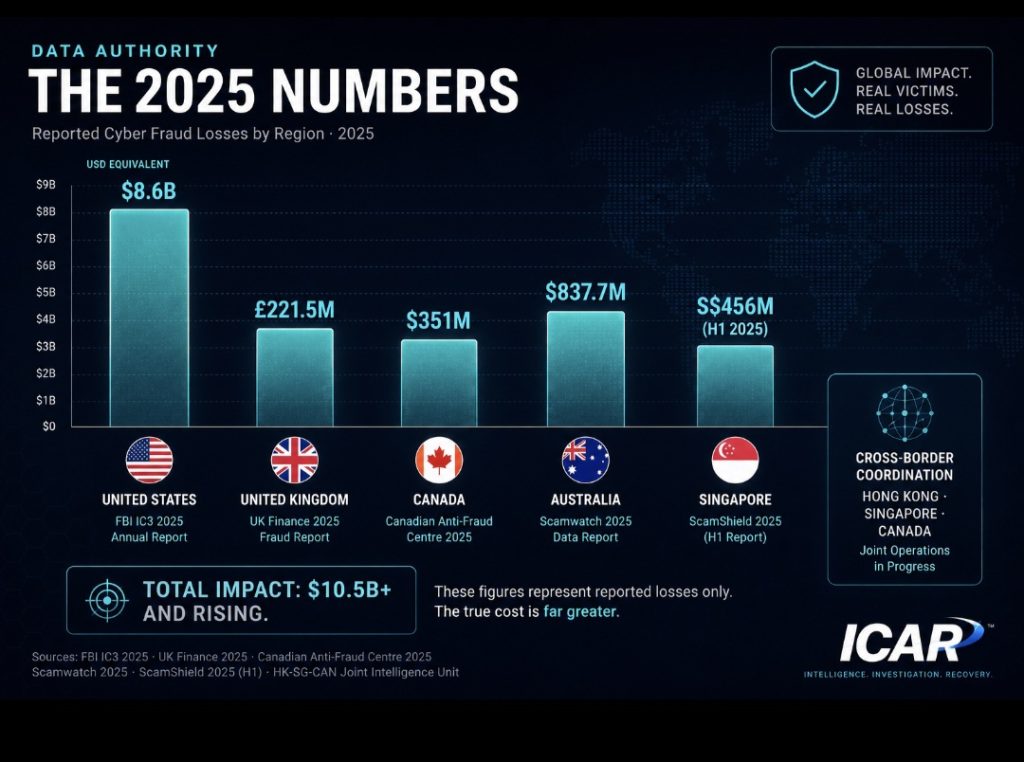
Investment scams took more money from victims in 2025 than almost any other form of fraud on earth. In the United States alone, the FBI’s Internet Crime Complaint Center logged over $8.6 billion in reported investment fraud losses more than business email compromise and tech support scams combined. In the UK, losses jumped 40% year-on-year to a record £221.5 million. Australia recorded $837.7 million lost to investment scams, and Canada’s Anti-Fraud Centre reported $351 million in investment fraud losses for the year. These are only the reported figures, investigators and regulators across every region agree the true toll is several times higher, since most victims never come forward.
If you’re reading this because you’ve already lost money, or because something about an “opportunity” you’ve been offered doesn’t sit right, this guide is built for you. It explains how investment scams actually work, the patterns that repeat across every version of the con, what to do in the first 24 hours after realising you’ve been targeted, and how professional asset recovery and blockchain tracing can help once the immediate crisis has passed.
| $30B+
Estimated combined investment scam losses reported across the UK, US, Canada, Australia, and Singapore in 2025 Source: FBI IC3, UK Finance, National Anti-Scam Centre, CAFC, Singapore Police Force — 2025/2026 annual reporting |
What Is an Investment Scam?
An investment scam is any scheme that persuades a victim to hand over money based on a promised return that the scammer never intends, or is never able to deliver. The “investment” itself is usually fictitious: a trading platform with no real market access, a cryptocurrency fund with no underlying assets, or a property or commodity scheme that exists only as a website and a set of fabricated account statements.
What separates investment scams from simpler theft is the build-up. Victims aren’t tricked in a single moment; they’re guided through a process, contact, credibility-building, a small “win,” pressure to reinvest, and finally the block or disappearance. Regulators increasingly describe this as a criminal operating model rather than a series of isolated incidents, because the sequence repeats with remarkable consistency across victims, countries, and platforms.
The Scale of the Problem in 2026
The figures below are the clearest evidence that investment fraud is not a niche risk, it is the dominant form of financial cybercrime worldwide.
United Kingdom
UK Finance’s Annual Fraud Report found investment scam losses rose 40% to £221.5 million in 2025, with nearly 15,000 cases reported involving fake opportunities in cryptocurrency, gold, wine, property, and carbon credits. City of London Police, which now runs the national reporting service that replaced Action Fraud, recorded 34,673 investment fraud reports in 2025, a 31% rise, with average losses of £25,612 per victim, frequently drawn from pension savings.
United States
The FBI’s 2025 Internet Crime Report recorded investment-related fraud as the largest single component of all reported losses, at over $8.6 billion, ahead of business email compromise and tech support scams. Cryptocurrency was central to this: crypto investment fraud alone caused over $7.2 billion in reported losses, and the average loss climbed to $62,604 once cryptocurrency was involved in the scheme. Americans aged 60 and over reported $7.7 billion in losses, a 60% increase on the previous year.
Canada
The Canadian Anti-Fraud Centre reported investment fraud losses of $351 million in 2025, the single largest category ahead of relationship scams and job scams, in what the CAFC has called its worst fraud year on record. The CAFC estimates that only 5–10% of fraud victims ever come forward, meaning true losses are likely far higher.
Australia
The National Anti-Scam Centre’s Targeting Scams Report found investment scams were the single largest loss category at $837.7 million out of $2.18 billion in total scam losses for 2025, with Australians aged 65 and over 17.1% of the population, accounting for 26.5% of total losses.
Singapore
The Singapore Police Force recorded S$456 million lost to fraud in the first half of 2025 alone, with cryptocurrency-related fraud making up nearly 18% of total losses.
Hong Kong
The Anti-Deception Coordination Centre continues to work alongside regional partners including Singapore and Canada on cross-border investment fraud networks, reflecting how these scams now operate as coordinated, multi-jurisdiction enterprises rather than isolated local incidents.
Common Types of Investment Scams
Cryptocurrency investment fraud
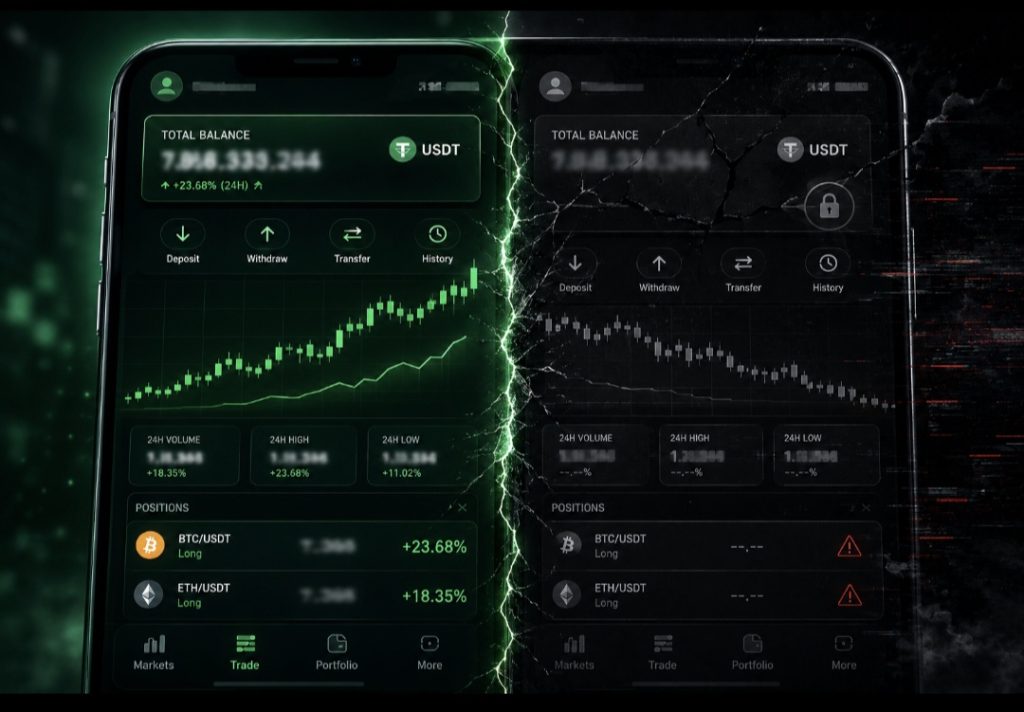
Currently the largest and fastest-growing category. Victims are directed to a fake trading app or website that displays a rising balance, but the underlying “exchange” is entirely fabricated and no real cryptocurrency is ever purchased. Withdrawal requests are met with fabricated “tax” or “unlock” fees designed to extract further payments.
Pig butchering scams
Combine romance or friendship with investment fraud. A scammer builds a relationship over weeks or months, often starting with a “wrong number” text before introducing a lucrative trading opportunity. The emotional relationship is what makes victims resistant to warnings from family or their bank, and losses frequently continue well past the point where a stranger would have walked away.
Ponzi and high-yield investment schemes
Promise fixed, unrealistically high returns and pay early investors using the deposits of later ones. They collapse once new deposits slow, but by then organisers have often disappeared with the remaining funds, sometimes across multiple jurisdictions to frustrate recovery.
Fake trading platforms and forex/CFD scams
Mimic legitimate brokerages, complete with realistic dashboards, customer support lines, and fabricated regulatory claims, while never executing real trades on the victim’s behalf. Some go as far as issuing fake “regulatory licence numbers” that mirror real firms to survive a cursory search.
Celebrity and deepfake endorsement scams
Use AI-generated video or audio of well-known figures: business leaders, broadcasters, politicians, appearing to endorse a platform. UK regulators have specifically flagged AI-generated content and deepfakes as a major driver behind the 40% rise in investment fraud losses in 2025.
Recovery scams
Target people who have already lost money. A “recovery agent” contacts the victim claiming they can retrieve the funds for an upfront fee and disappears once paid. This is one of the most common secondary scams ICAR encounters, and one reason we never charge upfront recovery fees.

Why Victims Fall For It
None of this is a matter of intelligence or carelessness. Regulators and behavioural researchers consistently point to the same mechanics: scammers build trust gradually, manufacture urgency (“this opportunity closes tonight”), borrow authority (fake regulator logos, fabricated licences, deepfake endorsements), and isolate victims from people who might raise doubts. Research cited by U.S. fraud prevention bodies found consumers who have simply heard about a specific scam type beforehand are 80% less likely to engage with it, and 40% less likely to fall victim if they do engage, which is precisely why awareness content like this guide measurably reduces harm.
What To Do If You’ve Been Targeted or Scammed
- Stop sending money immediately. Do not make “one more payment” to unlock a withdrawal, release funds, or pay a “tax” this is always part of the scam.
- Preserve everything. Screenshot conversations, transaction IDs, wallet addresses, website URLs, and any documents before accounts or platforms disappear.
- Contact your bank or exchange directly using the number on the back of your card or the official app: not a number given to you by the scammer, to flag the transactions and ask about a recall or freeze.
- Report to your national fraud authority (see region-specific bodies below). Reporting matters even if you don’t expect your specific funds back: it feeds the intelligence that shuts down networks and protects the next victim.
- Be cautious of unsolicited “recovery” offers. Legitimate recovery firms do not cold-contact victims or demand upfront fees before any work begins.
- Get a professional case assessment. Blockchain tracing and wallet clustering can often establish where funds moved even when a platform has vanished but timing matters, so the sooner this starts, the better the odds.
How Professional Asset Recovery Works
Once immediate reporting is done, a forensic investigation firm can go further than a bank or local police report typically can. Blockchain tracing follows the movement of cryptocurrency across wallets and exchanges to identify where funds were consolidated or cashed out. Wallet clustering groups addresses controlled by the same actor, often revealing links to other known scam operations. OSINT investigation builds a picture of the individuals or networks behind a scheme using open-source intelligence, company registries, domain records, social media footprints that can support law enforcement referrals or exchange cooperation requests to freeze funds before they disappear further.
This work doesn’t guarantee recovery no legitimate firm can promise that, but it materially improves the odds of identifying a viable recovery path, and it produces the kind of documented evidence that police, regulators, and exchanges need to act.
How to Report Investment Fraud, by Region
- UK — Report Fraud (the national service that replaced Action Fraud) and the Financial Conduct Authority’s Warning List
- US — the FBI’s Internet Crime Complaint Center (IC3) and the Federal Trade Commission (FTC)
- Canada — the Canadian Anti-Fraud Centre (CAFC) and the Canadian Securities Administrators
- Australia — Scamwatch (National Anti-Scam Centre) and ASIC
- Singapore — the Singapore Police Force Anti-Scam Centre and ScamShield
- Hong Kong — the Anti-Deception Coordination Centre (ADCC)
Frequently Asked Questions
Is it possible to get money back after an investment scam?
Recovery is case-dependent and never guaranteed, but outcomes are meaningfully better when reporting and tracing begin quickly, especially for cryptocurrency that hasn’t yet been laundered through multiple wallets or off-ramped to fiat.
How can I tell if an investment opportunity is a scam before I send money?
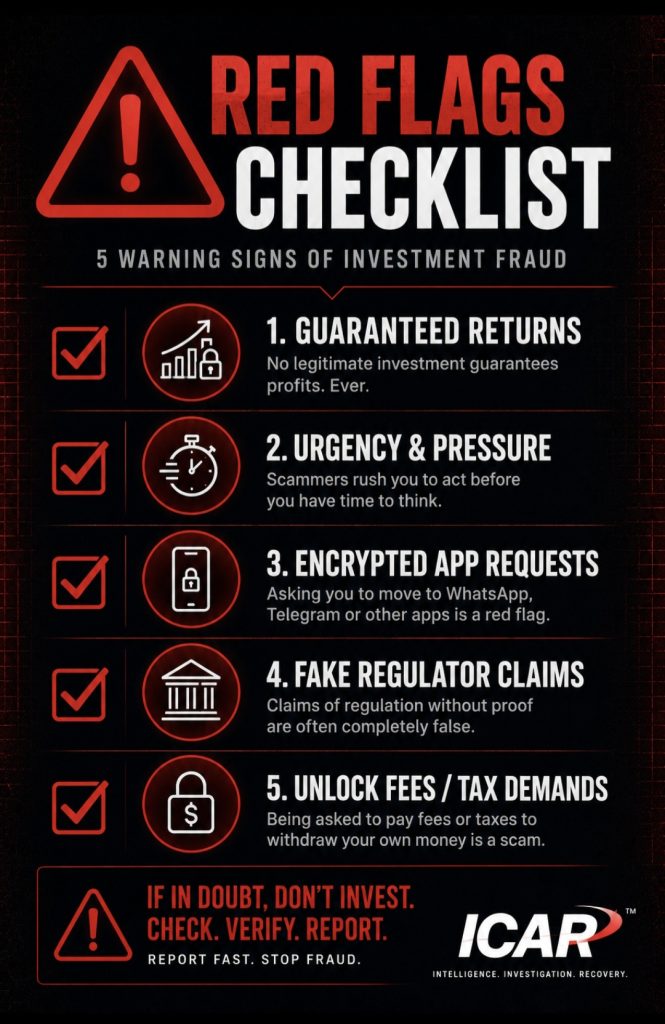
Warning signs include guaranteed or unusually high returns, pressure to decide quickly, requests to move communication to encrypted apps, unregistered or unverifiable regulatory claims, and any request to pay a fee to “unlock” your own funds.
Do I need to pay upfront for asset recovery services?
Be wary of any recovery firm demanding large upfront fees before any investigation has begun, this is a common secondary scam. Legitimate firms are transparent about fee structures tied to actual investigative work.
What’s the difference between a Ponzi scheme and a pig butchering scam?
A Ponzi scheme pays earlier investors with later investors’ deposits and usually involves no personal relationship. A pig butchering scam is built on a manufactured personal or romantic relationship that’s used to introduce the fraudulent investment.
Why do scammers use cryptocurrency so heavily?
Crypto transactions are fast, cross-border, and harder to reverse than traditional bank transfers, which is why crypto-related fraud accounted for over $11 billion in reported US losses in 2025 alone.
Should I contact the police or a recovery firm first?
Both, and in parallel — filing an official report creates the paper trail that recovery efforts and any future prosecution depend on, while a specialist firm can begin tracing before evidence goes cold.
How long does an investment fraud investigation typically take?
It varies significantly by case complexity, number of wallets/jurisdictions involved, and exchange cooperation — an initial case assessment will usually give a realistic estimate specific to your situation.
If You’ve Been Targeted, You’re Not Alone
Investment scams succeed because they’re built to feel legitimate until the exact moment they aren’t. If you’ve lost funds or you’re worried a current “opportunity” might be one of these schemes, start with a free case assessment. ICAR’s investigators hold CFE, CAMS, CBA, CCI, CBIP, and CCE certifications and work across the UK, US, Canada, Australia, Singapore, and Hong Kong to trace funds, cluster wallets, and build the evidence victims need to pursue recovery.
→ Free Case Assessment: Complete case form or contact support via WhatsApp