Recovery Scams: When Fraudsters Target You Again | ICAR
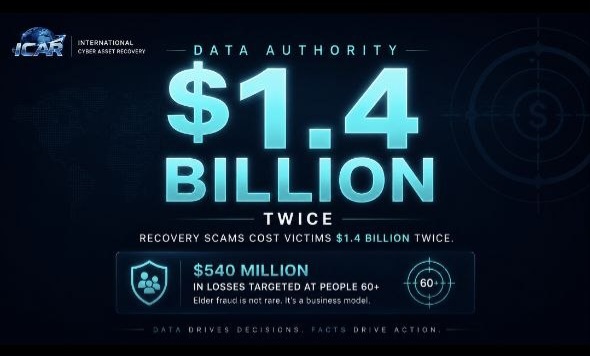
A recovery scam is a secondary fraud that specifically targets people who have already lost money to an earlier scam, offering to recover the lost funds in exchange for an upfront fee that, once paid, simply disappears along with the “recovery agent.” The FBI’s 2025 Internet Crime Report recorded more than 10,500 recovery scam complaints totaling $1.4 billion in losses, including $540 million taken specifically from victims aged 60 and older, across 2,529 complaints. This is the fifth and final Hub article in our Investment Scams cluster, and in some ways it’s the most important one to read regardless of which type of scam you may have encountered, because recovery scams specifically target victims of every scam type covered in our other four Hub articles: cryptocurrency fraud, pig butchering, Ponzi/HYIP schemes, and fake trading platforms. (See also: our Pillar guide, Investment Scams: The Complete Guide, and our Hub articles on Cryptocurrency Investment Scams, Pig Butchering Scams, Ponzi Schemes & High-Yield Investment Fraud, and Fake Trading Platforms & Forex/CFD Scams.) $1.4B Reported losses to recovery scams in 2025 — fraudsters specifically targeting people who had already lost money once Source: FBI Internet Crime Complaint Center, 2025 Annual Report Why Recovery Scams Work So Well Recovery scams exploit a specific emotional and financial state that makes victims unusually receptive: someone who has just lost money is often desperate, ashamed, and actively searching for any way to undo what’s happened. A caller or message that arrives claiming to already know the details of the original scam, sometimes because the same criminal network sold that information, sometimes because the recovery scammer is affiliated with the original scam operation itself, feels credible precisely because it demonstrates specific knowledge a stranger shouldn’t have. The FTC has documented that scam operations frequently maintain what they internally call “sucker lists” (records of who has already paid, how much, and what pitch worked on them) which get sold, traded, or reused to run a second scam against the same victim, sometimes years after the original loss. This turns a single fraud into an ongoing cycle: the 2026 Identity Theft Resource Center Trends in Identity Report found that just over a quarter of identity crime victims were managing two or more incidents simultaneously. There’s also a psychological dimension worth naming directly. A person who has just been defrauded is frequently experiencing a specific kind of urgency that has nothing to do with the recovery pitch itself: the desire to fix the mistake before anyone finds out, before a spouse or adult child asks hard questions, before the financial hole becomes permanent. A recovery scam offer arrives at exactly the moment that urgency is highest, promising a way to make the whole thing disappear quietly and completely, which is precisely the emotional state that overrides the skepticism the same person might apply to almost any other unsolicited financial offer. How the Pitch Usually Works Recovery scammers typically make contact by phone, email, or text, identifying themselves as a law firm, a government agency, a financial regulator, or occasionally a cybersecurity or asset-recovery firm. The FBI has specifically warned that scammers produce documents on convincing law firm letterhead, claim affiliation with agencies like the Consumer Financial Protection Bureau, and reference real financial institutions by name to build credibility quickly. The pitch usually follows a consistent shape: they already know you lost money (sometimes with unsettling specificity about the amount or the platform involved), they claim to have identified where the funds went or secured a legal mechanism to recover them, and they need a retainer, processing fee, tax payment, or your banking details to “release” or “process” the recovered funds. Once paid, the retainer disappears along with the recovery agent, and the victim has now lost money twice to what may be the exact same criminal organization. The documentation these operations produce has grown notably more sophisticated. Fabricated case numbers, official-looking seals, and letterhead mimicking real government agencies or established law firms are now common enough that a document’s visual polish alone should never be treated as proof of legitimacy, genuine government correspondence rarely arrives as an unsolicited cold contact promising a specific dollar recovery in exchange for an upfront payment. How Recovery Scams Target Each Type of Original Fraud It’s worth being specific about how this plays out across the four scam categories covered elsewhere in this cluster, since the recovery pitch is often tailored to match the original fraud precisely. Following crypto investment fraud Victims of crypto scams are frequently approached by someone claiming to be a “blockchain recovery specialist” or “crypto forensics firm” who claims to have already traced the stolen funds and can recover them for a fee paid in cryptocurrency itself. Following pig butchering scams Victims of relationship-based scams are sometimes approached by someone posing as a victim advocate or a fellow victim who has “already recovered” their own funds and offers to connect the new victim with the same recovery contact, exploiting the same trust-building mechanism that made the original scam work. Following Ponzi/HYIP collapses Investors in a collapsed Ponzi scheme are frequently targeted by fraudsters posing as the court-appointed receiver or a law firm representing the receivership, requesting an upfront “processing fee” to release a claims-process distribution, a tactic that works precisely because a real receivership claims process does exist and does eventually distribute funds, making the fake version harder to distinguish from the legitimate one. Following fake trading platform losses Forex and CFD scam victims are often approached by someone claiming to specialize in regulatory complaints or chargebacks, offering to handle the entire dispute process for an upfront fee, even though (as covered in our Forex/CFD Hub) a legitimate chargeback dispute is something a victim can typically initiate directly with their own card issuer at no cost. The Particularly Cynical Twist: Impersonating Real Victim-Protection Programs One of the more troubling patterns the FBI has flagged is that fraudsters have begun impersonating the Bureau’s own legitimate victim-outreach initiative, Operation Level Up — the program that proactively identifies and contacts
Recovery Scams: When Fraudsters Target You Again | ICAR Read More »