

When a fraud victim asks whether their stolen cryptocurrency can be traced, the honest answer is: it depends — but more often than it used to, yes.
The persistent belief that cryptocurrency is anonymous, untraceable, and therefore the perfect instrument for financial crime is one of the most consequential misconceptions in the current fraud landscape. It deters victims from reporting, discourages law enforcement from pursuing crypto cases, and — most harmfully — it is simply not true.
Every transaction on a public blockchain is permanently, immutably recorded. Bitcoin’s ledger has been public since the genesis block in January 2009. Ethereum’s since 2015. TRON’s since 2018. Every transfer, every wallet address, every timestamp — all of it is visible to anyone with access to a blockchain explorer and the expertise to interpret what they see.
What cryptocurrency investigation requires is not access to secret information. It requires the methodology to interpret public information, the tools to map complex transaction networks, the investigative skills to link on-chain data to off-chain identities, and the legal knowledge to translate forensic findings into actionable recovery steps.
This article explains that methodology — the five-phase process ICAR uses to investigate cryptocurrency fraud cases and pursue asset recovery.
Why the Blockchain Is the Investigator’s Greatest Advantage
Traditional financial fraud is notoriously difficult to trace. Bank records require legal process to access. Wire transfers pass through correspondent banking chains that can span multiple jurisdictions with varying disclosure standards. Cash is essentially invisible once withdrawn.
Blockchain changes this dynamic fundamentally. A public blockchain is, by design, a permanent, distributed, publicly accessible ledger of every transaction that has ever occurred on it. When a fraud victim’s funds enter the Bitcoin or TRON or Ethereum network, they create a trail that cannot be deleted, altered, or hidden — only followed.
The challenge for investigators is not access — it is interpretation. Raw blockchain data is a series of cryptographic hashes, wallet addresses, and transaction IDs that convey no inherent meaning about the people or organisations behind them. Converting that raw data into actionable intelligence about who holds a wallet, where they are located, and how funds can be frozen requires a combination of on-chain analysis, wallet clustering heuristics, open-source intelligence, and legal correspondence with exchanges.
| MYTH | FACT |
| Crypto is anonymous — once it’s gone, no one can trace it. | Every transaction is permanently recorded on a public blockchain. Professional investigators can trace, cluster, and attribute wallet addresses to real-world identities and exchanges. |
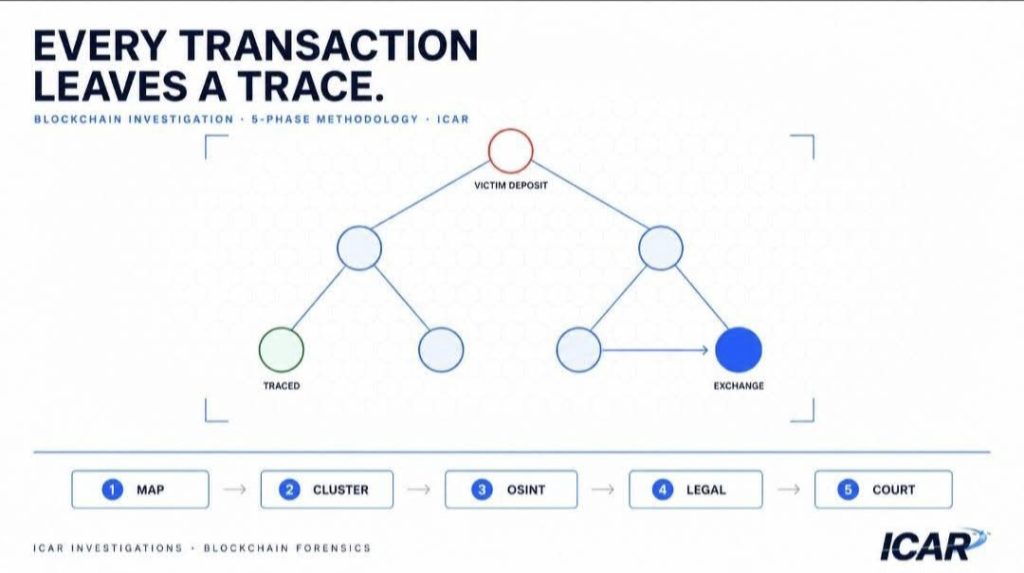
Phase 1: On-Chain Transaction Mapping
The investigation begins with what is known: the victim’s transaction records.
In a typical crypto fraud case, the victim has made one or more transfers — either directly in cryptocurrency from their own wallet, or via a bank transfer to a cryptocurrency exchange that then forwarded funds to addresses specified by the fraudulent platform. The first investigative task is to locate these transactions on the blockchain and map their subsequent movement.
| 1 | On-Chain Transaction Mapping
Starting from the victim’s known deposit addresses, investigators use blockchain explorers and analytics tools to map every transaction — tracing funds through each wallet address they touch, recording timestamps, amounts, and transaction IDs. |
| • Identify the blockchain network(s) involved — Bitcoin, Ethereum, TRON, BNB Chain, etc.
• Locate victim’s deposit transactions using bank records, exchange confirmations, or wallet addresses provided by the fraudulent platform • Map all outgoing transactions from those deposit addresses, following every hop • Record the full transaction graph: addresses, amounts, timestamps, block heights • Identify asset conversion points — where BTC is swapped to USDT, for example |
Asset conversion is a critical juncture in most modern crypto fraud cases. Fraudulent operations increasingly convert Bitcoin or Ether to USDT (Tether) — a stablecoin pegged to the US dollar — as quickly as possible after receiving victim deposits. This conversion serves two purposes: it locks in the dollar value (preventing loss from crypto price movements) and moves the funds to the TRON or Ethereum network where transaction volumes are higher and attribution is more complex.
| ▌ EXAMPLE — On-Chain Transaction Map Fragment |
| // Victim deposit address (Bitcoin network)
1A7xK3mNpQrLzV9sE8wYtDfCbHuMoJi2G → received 0.847 BTC [Block 894,221]
// First hop — funds moved within 6 minutes 1A7xK3… → 3PxFmQnRsTuVwXyZ4aBcDe… [0.847 BTC] [Block 894,223]
// Conversion — BTC swapped to USDT-TRC20 3PxFmQ… → DEX bridge transaction → TXYzAb1234CdEf5678GhIj… // TRON network — 25,847 USDT-TRC20 [timestamp: +00:22:14 from deposit]
// Layering hops — TRON network TXYzAb… → [Hop 1] → [Hop 2] → [Hop 3] → DESTINATION CLUSTER // Total elapsed: 4 hours 17 minutes from victim bank transfer |
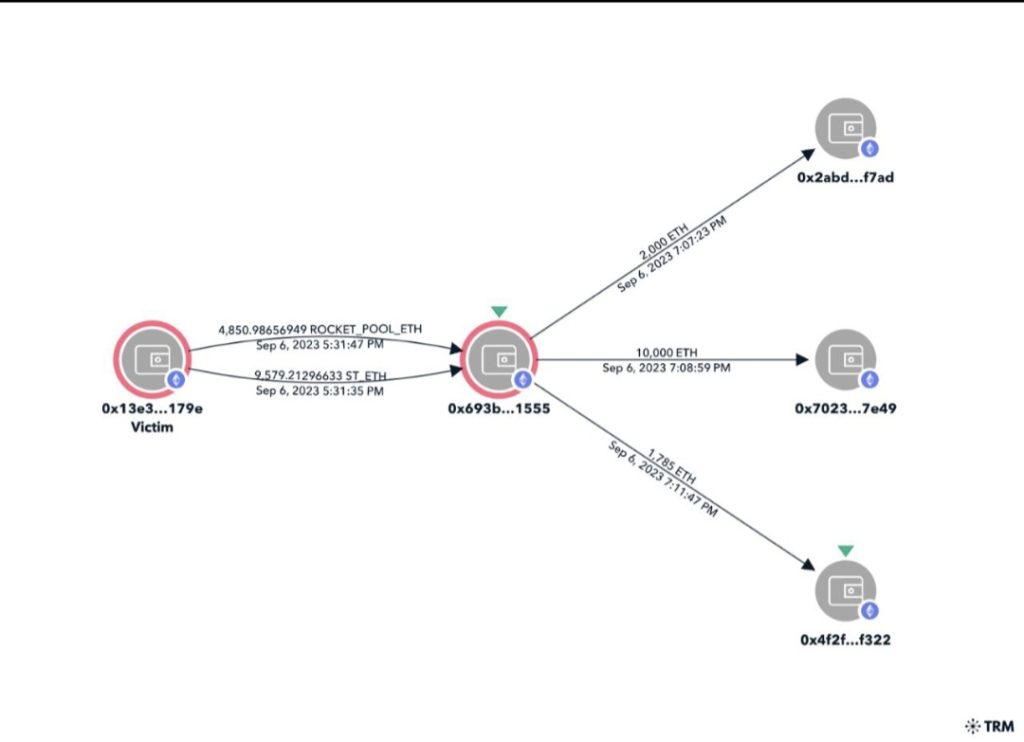
Phase 2: Wallet Clustering
A single criminal operation typically controls thousands of wallet addresses — using different addresses for each victim, each transaction, or each stage of the laundering process. On the surface, this appears to make attribution impossible. In practice, blockchain heuristics allow investigators to group addresses that are almost certainly controlled by the same entity.
| 2 | Wallet Clustering
Using behavioural heuristics — patterns in how addresses are used, funded, and emptied — investigators group wallet addresses into clusters that represent single controlling entities. This is one of the most powerful tools in blockchain forensics. |
| • Common-input ownership heuristic: if two addresses are used as inputs in the same transaction, they are likely controlled by the same entity
• Timing analysis: addresses that receive and empty funds in identical time windows suggest coordinated control • Amount clustering: fractional amounts that appear across multiple addresses suggest automated batch processing • Address reuse detection: entities that reuse addresses across multiple transactions expose control patterns • Peel-chain identification: long chains of single-input, single-output transactions suggest automated layering scripts |
The value of wallet clustering in fraud investigation is that it reveals the true scale of an operation. When David’s case (referenced in yesterday’s case study) was investigated, ICAR’s clustering analysis identified that his destination wallets were part of a cluster receiving funds from fourteen other identified victim source addresses — suggesting a single operation running multiple parallel cases through the same infrastructure.
| 68%
Of victim funds in a typical case reach a traceable exchange cluster within 72 hours — ICAR casework analysis |
Phase 3: Open-Source Intelligence (OSINT) Attribution
On-chain analysis identifies wallets and clusters. OSINT identifies who controls them.
The bridge between an anonymous wallet address and a real-world identity is built from publicly available information — and fraudulent operations leave more of it than they realise.
| 3 | OSINT Attribution
Investigators use open-source intelligence techniques to link wallet addresses and fraudulent platforms to real-world identities, organisations, and locations — building a profile that supports exchange cooperation and legal action. |
| • Domain registration analysis — WHOIS records, registration dates, registrar identity, hosting infrastructure
• Infrastructure fingerprinting — shared hosting, SSL certificates, server IP ranges linking multiple fraudulent domains • Social media OSINT — reverse image search of profile photos, account creation dates, follower network analysis • Platform interface analysis — cloned front-end detection, source code comparison, embedded metadata • Messaging platform attribution — virtual SIM registrations, phone number OSINT, Telegram/WhatsApp metadata • Exchange OSINT — deposit address attribution via known exchange address ranges and public blockchain analytics • Corporate record searches — company registrations in relevant jurisdictions linked to platform operators |
OSINT frequently reveals patterns invisible to the fraud victim. A fraudulent platform registered forty-seven days before first contact, using a privacy-protected Seychelles registrar, sharing infrastructure with eleven other similarly named domains, with a Terms of Service document copied verbatim from a legitimate broker — this is not a coincidence. It is a signature.
| ▌ EXAMPLE — OSINT Attribution Summary |
| # PLATFORM: EdgeStrategies FX (illustrative)
Domain age: 47 days at victim first contact Registrar: NameSilo LLC (privacy-protected) Registrant: REDACTED — Seychelles privacy service SSL cert: Let’s Encrypt (automated / free) Hosting: Cloudflare CDN — origin IP masked Shared infra: 11 other domains (same IP cluster) Interface clone: 87% CSS match to legitimate EU broker FCA status: NOT REGISTERED Terms of Service: Word-for-word copy — only company name changed Profile image: Reverse search → Chinese lifestyle blog, 2019 Phone (James): Virtual SIM — registered Philippines provider |
Phase 4: Exchange Attribution and Legal Correspondence
The investigative value of identifying a destination exchange cluster is substantial — but only if that identification can be acted upon. Phase 4 converts forensic analysis into legal leverage.
| 4 | Exchange Attribution and Legal Correspondence
Once funds are attributed to a custodial exchange — an exchange that holds private keys on behalf of account holders — investigators can engage that exchange’s compliance team with a formal evidence package to request a freeze. Exchanges operating under AML regulations have a legal obligation to cooperate with properly evidenced freeze requests. |
| • Confirm the destination address belongs to a custodial exchange using blockchain analytics tools and known exchange address datasets
• Identify the exchange’s compliance jurisdiction and the legal framework governing their freeze obligations (UK MLR 2017, US FinCEN, Cayman CIMA, etc.) • Prepare a forensic evidence package: transaction trace, clustering analysis, OSINT report, victim statement, timeline • Draft a formal legal letter from instructed solicitors, citing the applicable AML/VASP cooperation framework • Submit to the exchange’s compliance team with a specified response deadline • Follow up with law enforcement referral (Action Fraud / police) to provide the exchange a parallel official request |
The key variable here is speed. Exchanges can only freeze funds that are still in the account. Once an account holder withdraws or transfers their balance, the freeze opportunity passes. In ICAR’s experience, the window between a fraudulent operation receiving funds and moving them offshore or to a self-hosted wallet is typically between 24 hours and two weeks — depending on the scale of the operation and the exchange’s transaction monitoring systems.
| MYTH | FACT |
| Exchanges won’t cooperate — they protect user privacy above everything. | Regulated exchanges are legally required to cooperate with properly evidenced AML freeze requests. Major exchanges including OKX, Binance, and Kraken have dedicated compliance teams that respond to legal correspondence from qualified investigators. |
Phase 5: Evidence Documentation and Legal Recovery
Securing a compliance freeze is not the end of the recovery process — it is the beginning of the legal phase. A frozen balance can only be released to a victim through a court order, exchange restitution procedure, or law enforcement referral that results in a criminal forfeiture.
| 5 | Evidence Documentation and Legal Recovery
ICAR prepares court-admissible documentation packages that translate forensic blockchain findings into evidence suitable for civil litigation, criminal referral, and judicial freeze applications — supporting victims’ legal teams in pursuing formal recovery orders. |
| • Chain-of-custody documentation for all blockchain evidence — ensuring admissibility
• Transaction graph visualisations — clear, court-readable maps of fund movement • Expert witness statement preparation — forensic findings explained for non-technical judges • Coordination with victim’s solicitors for civil injunction or freezing order applications • Law enforcement referral packages — Action Fraud, NCA, Metropolitan Police Cyber Crime Unit • Cross-border coordination — where funds have moved through multiple jurisdictions, ICAR coordinates with international legal contacts |
What Determines Whether Recovery Is Possible
Not every crypto fraud case results in recovery. The variables that most significantly determine outcomes are:
Speed of reporting: The single most important factor. Funds frozen before they leave a custodial exchange can often be recovered. Funds that have moved to self-hosted wallets, been converted to privacy coins, or withdrawn from exchanges are significantly harder to pursue.
Wallet type at destination: Custodial exchange wallets (where the exchange holds the keys) are recoverable via legal correspondence. Self-hosted or hardware wallets, where the scammer holds their own private keys, require law enforcement seizure — a higher legal bar.
Quality of evidence preservation: Victims who preserve screenshots, transaction records, WhatsApp conversations, and platform login credentials give investigators the maximum possible starting data. Victims who delete communications or attempt to log in repeatedly to the fraudulent platform can compromise the evidence chain.
Jurisdiction of the exchange: Exchanges regulated in the UK, EU, US, or Singapore typically cooperate well with properly evidenced legal requests. Exchanges operating in unregulated jurisdictions may not.
Layering complexity: Simple layering — funds moving through two or three wallets before reaching an exchange — is routinely traceable. Complex layering through mixers, cross-chain bridges, and privacy coins requires more sophisticated tools and increases investigation time.
A Note on Recovery Scams: The Forensic Standard
Because blockchain tracing is a specialist skill with significant commercial value to fraud victims, the recovery space attracts fraudulent operators who claim forensic capabilities they do not possess.
Legitimate blockchain investigation firms should be able to articulate their methodology clearly — explaining the tools they use, the phases of their investigation, and the realistic range of outcomes for a case of the victim’s type. They should never guarantee recovery, never request upfront fees to ‘unlock’ funds, and never contact victims unsolicited.
The methodology described in this article is ICAR’s standard operating procedure. We apply it to every case we accept, we document every phase, and we provide clients with a full forensic report regardless of outcome. Our investigators hold professional certifications including CFE, CAMS, CBA, CCI, CBIP, and CCE. We welcome questions about our process.
Action Steps: If You Have Been Defrauded
The following steps directly support a blockchain investigation:
- Preserve every transaction record — bank statements, cryptocurrency exchange confirmations, wallet addresses provided by the fraudulent platform.
- Screenshot all communications — WhatsApp, Telegram, email, and any messages sent through the fraudulent platform’s interface.
- Do not log in to the fraudulent platform again after discovering the fraud — repeated access may trigger data deletion.
- Note the exact URLs, domain names, and any company names used by the platform.
- Contact your bank immediately — provide them with the transaction dates and amounts.
- Report to Action Fraud (UK: 0300 123 2040) and obtain a crime reference number.
- Engage a qualified forensic investigator as early as possible — ideally within 24 to 48 hours of discovering the fraud.

About ICAR: International Cyber Asset Recovery (ICAR) is a UK-based forensic investigation and asset recovery firm specialising in cryptocurrency fraud, investment scams, romance fraud, and cyber-enabled financial crime. Submit Case form or contact support on WhatsApp to commence your recovery process.