
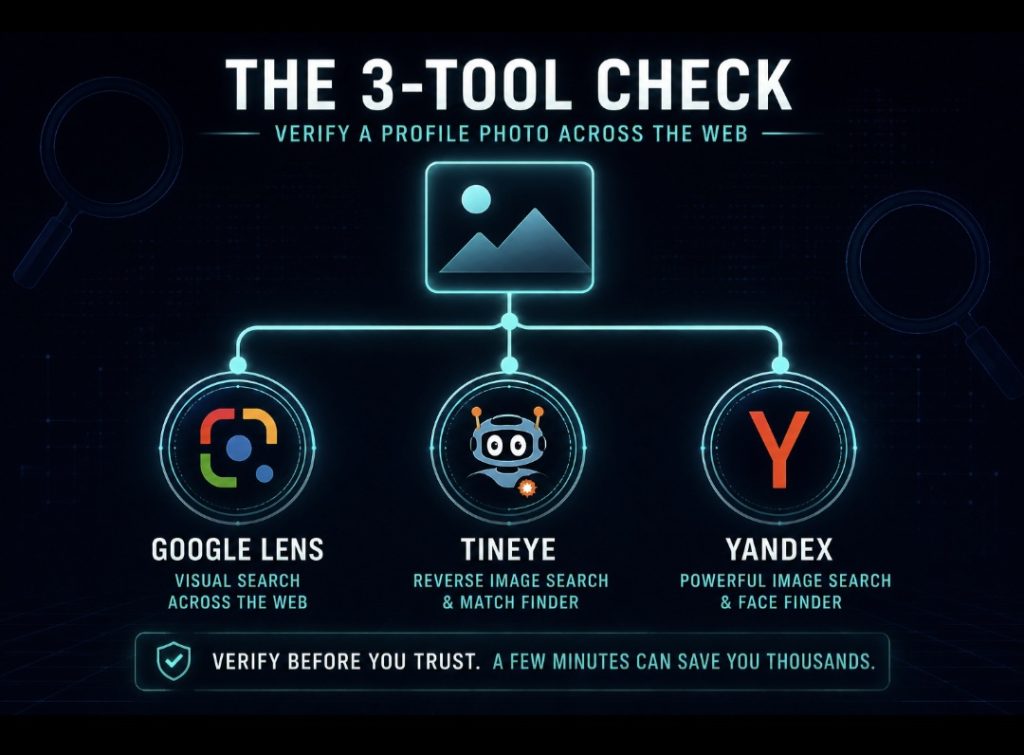
You can reverse image search a dating profile photo in under five minutes using free tools like Google Lens, TinEye, and Yandex, but in 2026, a clean result no longer tells you what it used to. AI image generators now produce photorealistic faces that have never been posted anywhere online, meaning there’s nothing for a reverse search to find, even when the profile is entirely fabricated. This guide covers the classic reverse-search process, the newer facial-recognition tools built specifically for this problem, and the video-call verification techniques that catch what image search alone can’t. (This is a companion piece to our Hub article, Pig Butchering Scams Explained, and our Pillar guide, Investment Scams — The Complete Guide.)
| 5% Report Rate
Only an estimated 5% of romance scam victims report it, meaning the FTC’s yearly count likely represents a small fraction of actual cases Source: FTC romance scam reporting data, industry analysis 2026 |
Step 1: Screenshot the Photo Properly
Save or screenshot every photo the person has sent or that appears on their profile, not just the main profile picture. Scammers often reuse a consistent set of images across multiple fake profiles, so checking two or three photos, not just one, meaningfully improves your odds of a match. Crop tightly to the face and upper body where possible; a clean, front-facing image returns better results than one that’s heavily filtered, cropped awkwardly, or taken from an angle.
Step 2: Run a Standard Reverse Image Search
Google Lens (upload the image directly at images.google.com or through the Lens app) is the most widely used starting point, and TinEye and Yandex’s image search are worth running as second and third sources, since each indexes a different slice of the web and can surface results the others miss, Yandex in particular has a reputation for stronger facial matching than Google Lens on certain image types. Upload the same photo to all three if the first search comes back empty; a miss on one tool doesn’t mean a miss everywhere.
What you’re looking for: the same photo appearing under a different name, on a modeling or stock-photo site, attached to a news article, or flagged on a scam-reporting site. Any of these is close to definitive, a real person’s dating profile photo showing up as a professional stock image licensed for commercial use is not a coincidence.
Step 3: Use a Dedicated Facial Recognition Search
Standard reverse image search matches identical or near-identical files. Facial recognition tools like PimEyes and FaceCheck.ID go further, analyzing facial geometry (the distance between eyes, nose width, jawline shape) to find the same face even in a completely different photo, taken at a different angle or in different lighting. This matters because a scammer using a stolen identity often has access to multiple real photos of that person, not just the one they’ve reused, and a geometry-based search can surface those even when a standard reverse image search comes back empty.
A note on using these tools responsibly: facial recognition search raises real privacy considerations, and reputable tools in this category position themselves specifically for personal-safety verification, confirming who you’re actually talking to, rather than surveillance of someone who hasn’t given you their photo directly. Use these tools only on photos sent to you directly as part of verifying an online relationship, not to search for or track someone who hasn’t shared their photo with you.
The 2026 Problem: AI-Generated Faces Leave No Trail
Here’s the wrinkle that’s changed this entire process over the past year or two: AI image generators can now produce a photorealistic human face that has never existed and has never been posted anywhere. A reverse image search, regardless of which tool you use, works by matching a file against an index of images that already exist online. A unique, never-before-posted AI-generated face simply has no origin to trace and no match to find. A completely clean result across every tool in this guide no longer proves the person is real.
This means reverse image search needs to be paired with a second layer: recognizing the visual signature of an AI-generated photo directly. A few tells that still hold up reasonably well: AI-generated faces often show subtle asymmetry in details like earrings, glasses, or jewelry that don’t quite match between the two sides. Real people’s photo collections are messy: group shots, bad lighting, selfies from years ago, photos where they’re not looking directly at the camera, an AI-generated persona typically has only a small handful of flawless, professional-looking headshots and nothing else. And backgrounds in AI-generated images sometimes carry subtle distortions or textures that look slightly wrong on close inspection, even when the face itself looks convincing.
Step 4: The Video Call Test
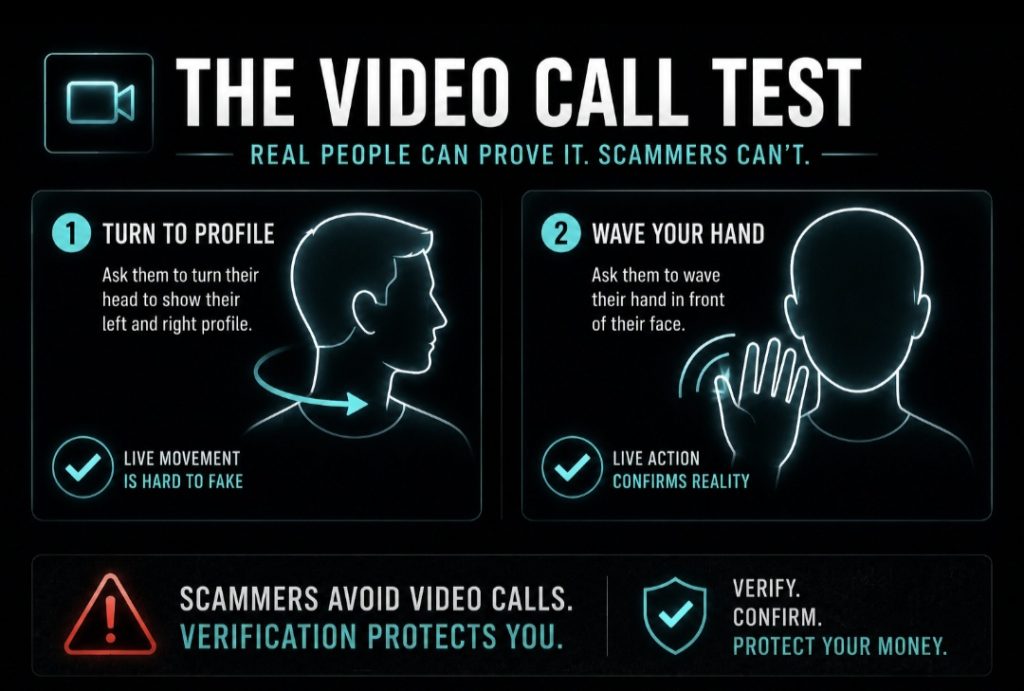
If reverse image search comes back clean and something still feels off, the most reliable next step is requesting a live video call, but even this now requires a specific approach, since deepfake video filters have become sophisticated enough to convince a casual observer. During the call, ask the person to turn their head fully to the side, in profile; real-time deepfake filters frequently break down or glitch at extreme angles that the underlying model wasn’t trained to handle smoothly. Also ask them to wave a hand slowly in front of their own face, filter-based deepfakes often glitch or distort around fast-moving objects passing in front of the tracked face.
Someone who refuses a video call entirely, or who always has a convincing reason it’s not possible right now (a broken camera, a work restriction, being deployed overseas) is itself one of the clearest patterns covered in our : Pig Butchering Hub article, regardless of what any image search turns up.
What a Clean Result Does and Doesn’t Mean
- A reused photo (found on a stock site, a different name’s profile, or a scam-report database) is close to definitive proof of a fake profile
- A completely clean result across every tool is reassuring but not proof because it’s consistent with both a real person and a well-executed AI-generated persona
- The strongest combined signal is a clean image search plus a successful, unedited video call where the person passes the profile-turn and hand-wave checks
- Cross-checking the person’s name, claimed employer, or other identifying details against public records adds another independent layer, a real person generally leaves a consistent trail across multiple platforms; a fabricated persona usually doesn’t
If You Confirm the Profile Is Fake
- Stop all contact immediately, and do not send any money, gift cards, or further personal information.
- Do not tell the person you’ve discovered the deception before disengaging, some scammers escalate pressure or threats once they sense they’re about to lose access to a victim.
- Report the profile to the platform it’s on, and to your national fraud authority if any money has already changed hands.
- If funds were sent, particularly via cryptocurrency, a professional case assessment can help determine whether tracing is worthwhile based on how the funds moved.
Frequently Asked Questions
Is it legal to reverse image search someone’s dating profile photo?
Generally yes — searching a photo someone has shared directly with you, for your own personal-safety verification, is standard practice and supported by every major tool in this space. It becomes an ethical and potentially legal concern only if used to track or surveil someone who hasn’t shared their photo with you directly.
What does a completely clean result actually mean?
It means the photo hasn’t been found elsewhere by the tools you used, which is reassuring but not proof of a real identity, since a unique AI-generated face will also return a clean result, having never been posted anywhere before.
Can reverse image search catch AI-generated photos?
Not when the image is genuinely unique and has never been posted anywhere else. It can, however, still catch AI-generated images that have been reused across multiple fake profiles, since at that point the image does have a trail to find.
Does passing a video call prove someone is real?
It significantly improves confidence, especially when combined with the profile-turn and hand-wave checks that current deepfake filters struggle with, but treat it as one strong signal among several rather than absolute proof on its own.
What should I do if I can’t get a clear answer either way?
Treat continued uncertainty as reason for caution, not reassurance, a real relationship can tolerate reasonable verification requests, and reluctance to accommodate them is itself meaningful information, regardless of what any single tool shows.
Related Reading
→ Parent Hub: Pig Butchering Scams Explained
→ Pillar guide: Investment Scams — The Complete Guide
→Free initial case assessments: Case Form or Contact Support via WhatsApp