
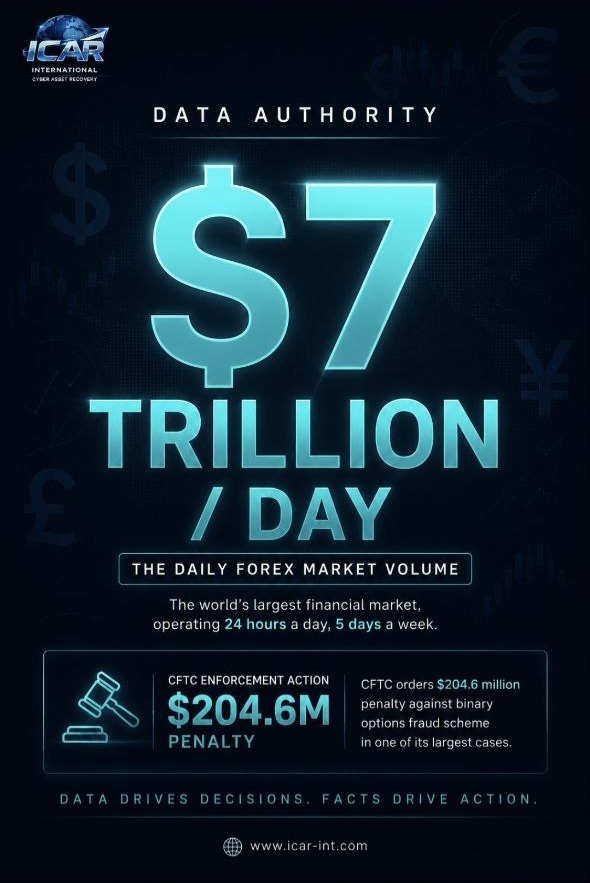
A fake trading platform scam involves a website or app that presents itself as a legitimate forex, CFD, or binary options broker while never executing real trades on a client’s behalf, or manipulating the trading software to guarantee client losses. The global forex market turns over more than $7 trillion a day, and that scale makes it an enormous target: the UK’s FCA maintains a daily-updated Warning List specifically because so many unauthorised brokers now operate, and the US CFTC runs dedicated advisories on binary options fraud because complaints have risen steadily as offshore platforms multiply. This article covers exactly how these platforms work technically, the specific tactic known as a “clone firm,” a 2026 case that shows even a real, verifiable licence number isn’t a full guarantee of safety, and what to do if you’ve been targeted.
| $7 Trillion
The forex market’s estimated daily trading volume — the scale that makes it such an attractive hunting ground for fraudulent brokers Source: UK Financial Conduct Authority; industry volume aggregates, 2025–2026 |
How Fake Trading Platforms Actually Work
The defining feature of this scam category is a dashboard that looks and behaves like a real trading platform without any of it reflecting genuine market activity. In the most basic version, deposits simply disappear — the “platform” was never connected to any market at all, and withdrawal requests are stalled indefinitely or denied outright, sometimes with a sudden “tax” or “compliance fee” demanded first.
In more sophisticated versions, particularly with binary options, the fraud is built directly into the payout mathematics. The CFTC has documented platforms where the expected value of every trade is structured to be negative for the client regardless of outcome, the payout for a winning trade is deliberately smaller than the loss on a losing one, so that even a coin-flip-accurate trader loses money on average over time. Some platforms go further and manipulate the software itself to generate losing trades outright, or alter displayed prices so that a position that should have closed in profit is shown closing at a loss instead.
A third variant sits in between these two: the platform does route some trades to real markets, often small, early ones, to build trust and produce genuine-looking statements, while quietly widening spreads, adding hidden fees, or requiring “liquidity provider” approval on larger withdrawals that never actually arrives. This hybrid version is harder to spot precisely because a portion of the early experience is real, which is exactly the point.
How These Scams Have Evolved: From Cold Calls to Social Ads
The underlying fraud hasn’t changed much in decades, but the distribution has. Where forex and CFD scams once relied heavily on cold-calling from offshore boiler rooms, most operations today build their initial contact through paid social media advertising, sponsored posts featuring convincing testimonials, or influencer partnerships promoting a platform’s “proprietary trading algorithm.” A prospective victim often discovers the platform through an ad that looks indistinguishable from a legitimate fintech company’s marketing, professional video production, a polished landing page, and social proof in the form of comments and testimonials that may themselves be fabricated or purchased.
Once initial contact is made, whether through an ad click or a cold call, the sales process itself has become more structured. Account managers are frequently given scripts specifically designed to overcome common objections: concerns about the guaranteed-return language, hesitation around a large deposit, or a request to “think about it” and are measured internally on deposit conversion rates the same way a legitimate sales organization would track any other KPI. Recognizing that you’re being worked through a script, rather than having an organic conversation with someone who has your interests at heart, is itself one of the more reliable defenses available.

Clone Firms: Wearing a Real Company’s Identity
One of the most effective tactics in this category is what the FCA calls a “clone firm” — a fraudulent operation that uses the actual name, firm registration number, and address of a real, FCA-authorised firm to appear legitimate to anyone who does a basic search. A victim who checks the firm registration number will often find it matches a real, regulated company, because it does; the fraudsters have simply borrowed that identity wholesale, typically operating through a lookalike website or a slightly altered domain name.
This is precisely why the FCA has built a dedicated verification tool that checks not just whether a firm registration number exists, but whether it’s actually connected to the entity you’re dealing with and the specific service being offered, because a clone firm will pass a naive “is this number real” check every time. The practical implication is that you should never navigate to a regulator’s verification page through a link the firm itself provided; always type the regulator’s URL directly or search for it independently, since a clone operation’s own website may link to a fabricated “verification” page designed to confirm whatever you’re hoping to see.
A 2026 Case That Complicates the Standard Advice
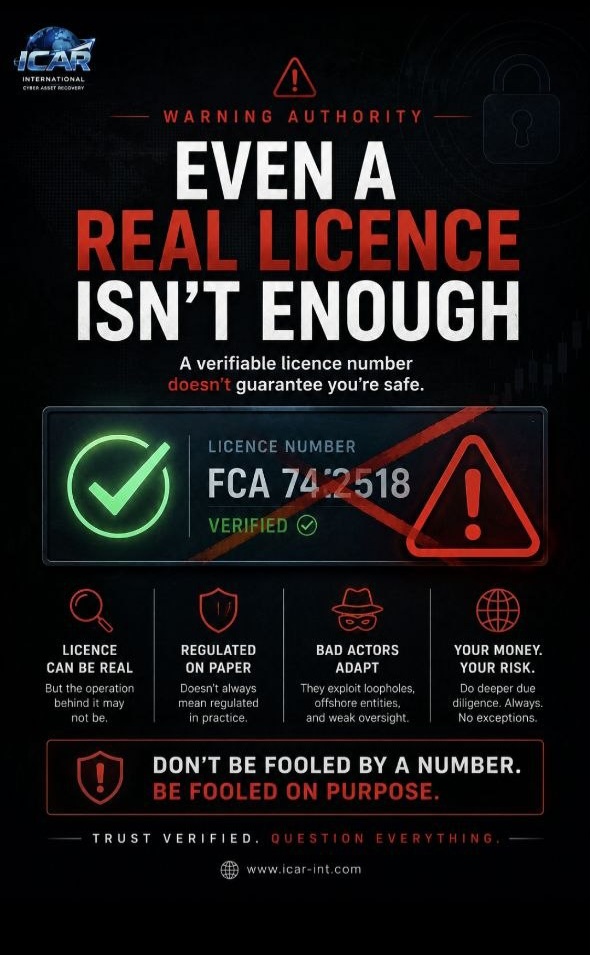
Most fraud-prevention guidance, including our own Ponzi/HYIP Hub article, centers on checking whether a firm or adviser is registered with the relevant regulator. That remains essential, but a 2026 enforcement action out of South Africa illustrates an important nuance: registration alone isn’t a complete safeguard. South Africa’s Financial Sector Conduct Authority provisionally withdrew the licence of a CFD broker operating under a real, verifiable FSP number, citing aggressive and manipulative high-pressure sales tactics, unauthorised advice, guaranteed-return promises, and inadequate risk disclosure. A second, related firm had been under investigation for months over similar conduct before its licence was pulled, despite trading under a number that would have passed a basic register check throughout that entire period.
The lesson isn’t that regulatory verification is pointless, it remains the single highest-leverage check available, and the vast majority of fraudulent brokers fail it outright. The lesson is that a passing registration check should be the start of your due diligence, not the end of it. High-pressure sales tactics, guaranteed-return promises, and pushback against your own risk tolerance are red flags regardless of what the licence register says. A regulator’s investigation into a licensed firm can also take months to become public, meaning a firm can be actively harming clients for a considerable period before its status changes on the register at all, another reason behavioral red flags matter alongside documentary ones.
Binary Options: A Structurally Different Risk
Binary options deserve specific attention because the product itself is easy to misunderstand. A binary option is a yes/no bet on whether a price will be above or below a certain level at a set time, legitimate versions exist on registered US exchanges, but the vast majority of binary options marketed to retail investors through internet-based platforms are unregistered and, per CFTC and SEC joint guidance, frequently fraudulent. Even setting fraud aside, the CFTC has noted that the payout structure of many binary options is mathematically designed so that the expected return is negative for the investor even under a genuine 50/50 probability, because the loss on a losing trade is structured to be larger than the gain on a winning one.
Fraudulent binary options operators layer additional tactics on top of that structural disadvantage: refusing to credit deposits that were supposedly made, denying legitimate withdrawal requests, requiring a minimum number of additional trades before any withdrawal is permitted, and in some documented cases, manipulating the software to generate losing trades directly. Some platforms also offer a deposit “bonus” (extra funds credited on top of an initial deposit) contingent on the client completing a specified, often very large, trading volume before any withdrawal is permitted at all, a condition that’s typically impossible to satisfy without losing the entire account balance first.
In one CFTC enforcement action, a global binary options fraud scheme resulted in a $204.6 million penalty order, with the agency crediting cooperation from the SEC, Canada’s Ontario Securities Commission, and Australia’s ASIC in uncovering the operation, underscoring how cross-border these schemes typically are, and why reporting to your own national regulator still matters even when the operators are based elsewhere entirely.
Boiler Room Sales Tactics
Many fake trading platforms are paired with an aggressive outbound sales operation sometimes called a “boiler room” where a persuasive account manager calls repeatedly, builds a personal rapport, and pushes for larger and larger deposits, often citing a time-limited market opportunity. These callers frequently have scripted responses to common objections and are trained specifically to overcome hesitation, which is why a legitimate-sounding, friendly, persistent account manager is itself worth treating as a signal rather than reassurance.
A pattern worth naming specifically: many victims describe their account manager becoming noticeably warmer and more personally attentive precisely as deposit requests scale up, remembering personal details, checking in outside of market hours, expressing genuine-sounding concern about the client’s finances. That warmth is not incidental. It’s a deliberate technique to make a large financial decision feel like it’s being made inside a trusted relationship rather than a transaction with a stranger, borrowing the same trust-building mechanism used in the relationship-based scams covered in our Pig Butchering Hub, just compressed into a shorter timeframe and wrapped in professional rather than romantic framing.
A Practical Verification Checklist Before You Deposit
- Navigate to the regulator’s website directly (typed manually, not clicked from the firm’s site) and search their register independently
- Confirm the firm’s registered contact details on the regulator’s site match what the firm itself has given you, a mismatch is a clone-firm indicator
- Ask the account manager directly what happens to your capital in a losing month, and note any evasiveness
- Search the firm’s name alongside “withdrawal problems” or “complaints” before depositing, not after
- Treat urgency, warmth, and pressure as data points about the salesperson’s technique, not the opportunity’s quality
Red Flags Specific to Fake Trading Platforms
- A firm registration number that, when checked directly with the regulator rather than through a link the firm provided, doesn’t match the entity you’re dealing with
- Guaranteed returns or guaranteed profit language of any kind — genuine trading carries real risk of loss
- Pressure to deposit more to “unlock” a withdrawal, cover a “tax,” or reach a minimum trading volume
- An account manager who calls frequently, builds personal rapport, and pushes urgency around limited-time opportunities
- A platform that only accepts card or crypto deposits and makes bank transfer withdrawal unusually difficult
- High-pressure sales tactics or dismissiveness toward your stated risk tolerance — even from a broker with a real licence number
What To Do If You’ve Been Targeted
- Stop depositing further funds, regardless of any pressure to “cover” a fee or unlock a withdrawal.
- Screenshot the platform, all correspondence, and every transaction before the site disappears.
- If you funded the account by credit or debit card, contact your card issuer about a chargeback — this is often the single highest-recovery-odds option available for card-funded losses, and has a limited time window, so act quickly.
- Verify the firm’s registration directly through the regulator’s own website or verification tool, not a link the firm gave you.
- Report to the FCA (UK), CFTC/NFA (US), ASIC (Australia), CIRO (Canada), MAS (Singapore), or SFC (Hong Kong).
- Get a professional case assessment, particularly if funds moved through cryptocurrency at any stage of the deposit or withdrawal process.
On the chargeback point specifically: card networks generally give you a defined window (often up to 120 days from the transaction, though this varies by issuer and card network) to dispute a charge as fraudulent or for goods/services not rendered. Document everything before you call: the platform’s URL, every communication with the “broker,” and a clear timeline of when you tried to withdraw and were refused. A well-documented dispute, filed promptly, meaningfully outperforms a vague one filed months later after memory of specifics has faded.

How ICAR Helps
Fake trading platform cases often involve funds that moved through payment processors, offshore entities, or cryptocurrency before reaching their final destination. ICAR’s investigators combine OSINT research into the operators behind a platform: company registries, domain records, and connections to previously flagged clone firms with blockchain tracing where crypto was involved, building the documentation needed for a chargeback dispute, a regulator complaint, or a law enforcement referral.
A meaningful share of the cases we see involve a hybrid payment path: an initial card deposit, followed by pressure to “top up” via cryptocurrency once card limits are reached or a card issuer’s fraud controls start blocking further transactions to the same merchant. That shift to crypto is rarely incidental — it’s frequently a deliberate move once a platform anticipates a card dispute, since crypto transactions are far harder to reverse. Identifying and documenting that shift matters for both your chargeback case and any subsequent tracing work, since it establishes a clear before-and-after point in how the fraud operated against you specifically.
How to Report Investment Fraud, by Region
- UK — the Financial Conduct Authority’s Warning List and firm verification tool
- US — the CFTC (forex/binary options/commodities) and the National Futures Association (NFA)
- Canada — the Canadian Investment Regulatory Organization (CIRO)
- Australia — the Australian Securities and Investments Commission (ASIC)
- Singapore — the Monetary Authority of Singapore (MAS)
- Hong Kong — the Securities and Futures Commission (SFC)
Frequently Asked Questions
What exactly is a clone firm?
A fraudulent operation that uses the real name, registration number, and address of a genuine, regulated firm to appear legitimate — checking the number alone won’t catch it, because the number is real; you need to verify it’s actually connected to the entity you’re dealing with, ideally through the regulator’s own verification tool, navigated to directly rather than via a link the firm provided.
Can a broker with a real, verifiable licence still be running a scam?
Yes — a 2026 South African enforcement case involved a licensed CFD broker under investigation for months over aggressive high-pressure sales and guaranteed-return promises before its licence was pulled. A passing registration check is a strong first filter, not a complete guarantee, particularly because a regulatory investigation can be underway for a considerable period before a licence status changes publicly.
Are binary options always a scam?
Not always — legitimate binary options exist on registered US exchanges, but the CFTC and SEC have jointly warned that the vast majority marketed to retail investors through internet-based platforms are unregistered and frequently fraudulent, and even legitimate payout structures can carry a negative expected value built into the mathematics.
Can I get my money back if I paid by credit card?
A chargeback through your card issuer is often the fastest, highest-odds recovery path for card-funded deposits, but has a limited time window (often up to 120 days depending on the card network and issuer) so contact your issuer as soon as you suspect fraud rather than waiting to see if the situation resolves itself.
How do I actually verify a broker before depositing money?
Go directly to the regulator’s own website (typed manually, not clicked from a link the firm sent you) and use their official verification or warning-list tool, then independently confirm the firm’s contact details match what the regulator has on file — a mismatch is a strong clone-firm indicator.
What makes forex/CFD scams different from the crypto scams in your other Hub article?
This article covers fraud built around traditional forex, CFD, and binary options products and regulatory licensing mechanics, including the specific clone-firm tactic; our Crypto Investment Scams Hub covers the technical mechanics specific to cryptocurrency wallets, exchanges, and blockchain-based fraud, which sometimes overlaps when a fake broker asks victims to fund accounts using crypto.
Is it worth reporting even if I don’t expect to recover my funds?
Yes — regulator reports feed the warning lists and investigations that get fraudulent platforms shut down and protect the next investor, and cross-border cooperation between regulators has led to significant enforcement actions, including a $204.6 million penalty in one CFTC case that relied on evidence and cooperation across four different countries’ regulators.
What should I do if my account manager becomes hostile or disappears once I ask to withdraw?
Treat this as confirmation, not an isolated bad interaction: a legitimate broker doesn’t need to pressure, guilt, or ignore a client for requesting their own funds. Stop all further contact aside from documenting it, and move directly to the chargeback and reporting steps above rather than continuing to negotiate.
Why Regulators Struggle to Keep Pace
It’s worth understanding why this category persists despite decades of regulatory attention: fraudulent brokers routinely operate from jurisdictions with weak or absent financial oversight while marketing aggressively into countries with strong regulators like the UK, US, and Australia. A platform can be incorporated in one country, hosted in a second, staffed from a third, and marketed specifically to victims in a fourth, meaning no single regulator has full jurisdiction, and cross-border enforcement cooperation, while improving, still takes considerably longer than a scheme typically needs to collect deposits and disappear. This is precisely why the FCA’s daily-updated Warning List and the CFTC’s Registration Deficient List exist as living documents rather than static resources — the population of fraudulent platforms turns over constantly, with new domains and new corporate shells replacing ones that get flagged, often within weeks.
A useful comparison point: our Pillar guide and Ponzi/HYIP Hub both emphasize checking regulatory registration as a primary defense, and that advice still holds broadly true across every scam category in this cluster. What this Hub adds is the specific caveat that registration checks need to be done independently rather than through any link or number the firm itself supplies, and that behavioral signals (pressure, guaranteed language, hostility toward withdrawal requests) remain meaningful even when the paperwork checks out.
If You’ve Been Targeted, You’re Not Alone
Fake trading platforms are built to survive a quick background check, which is exactly what makes them dangerous. If you’ve deposited funds with a broker that’s stopped honoring withdrawals, ICAR’s investigators can help trace where those funds went and build the case documentation your chargeback or regulator complaint needs.
The pattern across every case in this article: the clone firm, the licensed-but-fraudulent broker, the rigged binary options payout, is the same one running through this entire cluster, a scheme built specifically to survive the first layer of scrutiny most people apply. That’s not a reason to stop checking. It’s a reason to go one layer deeper than the standard advice, verify independently rather than through a link the firm gave you, and treat sales pressure itself as data rather than noise to push past.
→ Free Case Assessment: free-case-assessment
→ Contact Support via WhatsApp: WhatsApp