

LinkedIn forex scams are among the most sophisticated investment fraud operations ICAR investigates. They target a demographic rarely associated with fraud vulnerability, senior professionals, business owners, executives, and financially experienced individuals in their 40s and 50s, and they do so using the one platform that professional targets trust most: LinkedIn.
According to the FBI’s IC3 2025 Annual Report, investment fraud remains the single largest cybercrime loss category, with cryptocurrency investment fraud alone accounting for $7.2 billion in losses. The FTC has documented consistent growth in social media-enabled investment fraud, noting that professionals who would never respond to a cold email scam are systematically deceived through relationship-based approaches on professional networks.
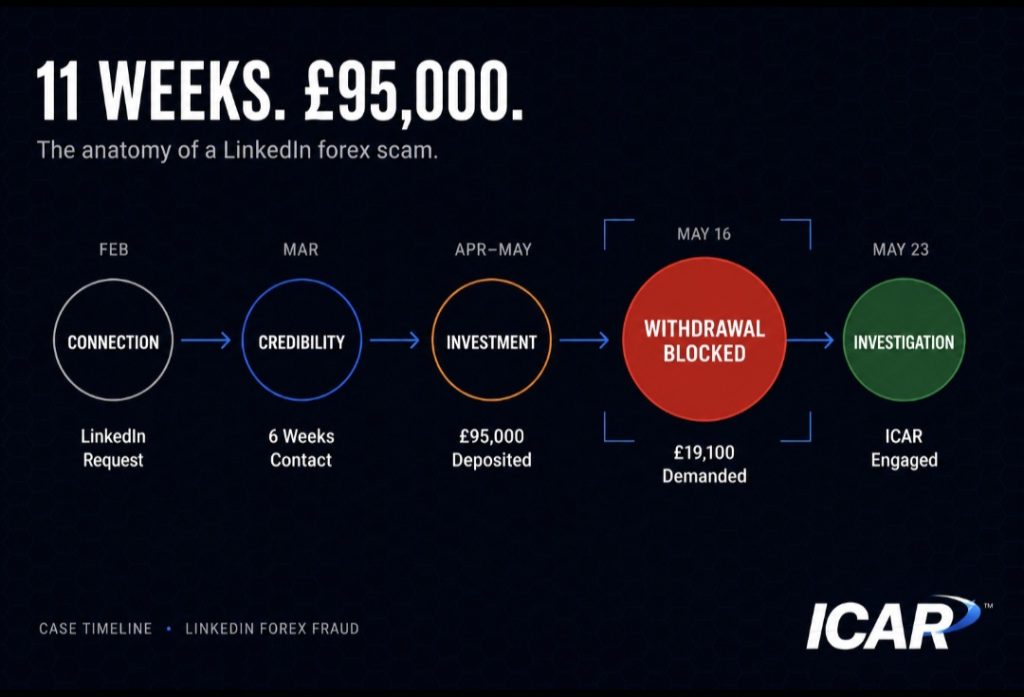
This article presents a forensically accurate case study of a LinkedIn forex scam, how it began, how it escalated, what ICAR’s investigation found, and what it tells us about the broader threat to professionals across the UK, US, Canada, Australia, Singapore, and Hong Kong.
| $7.2 Billion
Lost to cryptocurrency investment fraud in the US alone in 2025 Source: FBI IC3 2025 Annual Report |
The Case: Marcus and the Trading Expert
Marcus Chen is 51. He is the managing director of a mid-sized logistics company in Birmingham. He has used LinkedIn daily for twelve years for business development, industry news, and professional networking. He considers himself financially literate: he has a pension, ISAs, and a modest share portfolio managed by an IFA.
In February 2026, he received a LinkedIn connection request from a profile called James Whitfield described as a ‘Senior FX Strategist | Algorithmic Trading | 14 Years Market Experience’. The profile had a professional headshot, 4,287 connections, a complete employment history at named financial firms, and eleven endorsements for ‘Forex Trading’ and ‘Portfolio Management’. Two of Marcus’s existing connections were mutual contacts.
STAGE 1 The ConnectionFebruary 2026 — Initial contact and relationship building |
James’s first message was low-pressure and professionally framed:
‘Hi Marcus — I noticed we share connections with [Name 1] and [Name 2]. I work in FX strategy and occasionally share market insights with professionals in complementary sectors. Happy to connect if that’s useful.’
Marcus accepted. Over the following three weeks, James sent six messages, short, considered, market-relevant. He shared commentary on GBP volatility following a Bank of England announcement. He sent a note on a regulatory change affecting institutional forex trading. Nothing about investment opportunities. Nothing about his own returns.
| ⚑ | RED FLAG: Professional credibility was manufactured, not earned
The 4,287 connections, the endorsements, the employment history at named firms — all fabricated or inflated. Mutual connections create a false sense of verification. In ICAR’s OSINT investigation, the LinkedIn profile had been created 74 days before the connection request. The headshot was a stock image from a photography subscription service. |
STAGE 2 The IntroductionMarch 2026 — The investment conversation begins |
In late March, James mentioned briefly and without pressure, that his team had been running an algorithmic forex strategy with strong results in Q1. He was considering opening a small number of external positions for ‘trusted contacts’ at a flat management fee. He named the platform: PrimeForex Capital.
Marcus looked it up. The website was professional. Registered address in London. FCA registration number in the footer. A ‘Regulatory’ section with documentation. Client testimonials with photographs.
He checked the FCA register. He searched for ‘PrimeForex Capital.’ It appeared. He read the entry. The name matched. The registration number matched.
What Marcus did not notice because he did not know to look, was that the FCA registration belonged to a different firm: a legitimate, authorised brokerage that had nothing to do with PrimeForex Capital. The fraudulent platform had copied the registration number and company details of a real FCA-authorised firm. This is a clone firm impersonation, one of the most common techniques used in UK investment fraud.
| ⚑ | RED FLAG: Clone firm impersonation — FCA number belongs to a different authorised entity
The FCA maintains a warning list of known clone firms at fca.org.uk/scamsmart. Verifying requires matching the company NAME, registration NUMBER, and contact details simultaneously, a number that matches but belongs to a different firm is impersonation, not authorisation. Always verify all three elements independently. |
How PrimeForex Capital Was Built
ICAR’s subsequent OSINT investigation of PrimeForex Capital revealed the following:
| ▌ OSINT INVESTIGATION — PRIMEFOREX CAPITAL (FICTIONAL) |
| // Domain analysis
Domain: primeforexcapital.com Domain age: 61 days at victim first contact Registrar: Namecheap (privacy-protected) Registrant: REDACTED — Panamanian privacy service SSL certificate: Let’s Encrypt (automated, free)
// FCA impersonation FCA number claimed: [6-digit number from legitimate firm] Actual FCA holder: Different authorised brokerage (11 years registered) FCA ScamSmart: Clone firm warning NOT yet issued (platform too new) FCA register check: Number exists — but belongs to different entity
// LinkedIn profile — ‘James Whitfield’ Profile created: 74 days before connection request Headshot: Stock image — Getty Images subscription library Employment history: Named real firms — no verifiable tenure at any Connections: 4,287 — many purchased via third-party connection service Mutual connections: 2 — both passive LinkedIn users unlikely to be contacted
// Platform interface Interface clone: Matched EU-regulated forex broker (83% CSS similarity) Testimonial photos: Stock images — identified via reverse image search Regulatory section: Copied verbatim from legitimate broker’s compliance page
// Infrastructure Shared hosting IP: Resolved to known fraudulent domain cluster (14 domains) Server location: Netherlands — masked via Cloudflare CDN |
STAGE 3 The Deposit LadderApril–May 2026 — £95,000 transferred across 9 transactions |
Marcus’s first deposit was £5,000. His dashboard showed a 4.2 percent return in the first week. James sent a brief note: ‘Q1 was strong. We are anticipating continued momentum in GBPUSD positioning. Pleased with how your allocation performed.’
Over the next six weeks, Marcus made eight further transfers. The deposits escalated: £8,000, then £12,000, then £18,000. Each was accompanied by updated portfolio statements showing consistent gains. Each time Marcus suggested withdrawing some profit to test the platform, James advised patience ‘reinvestment compounds the position’ and Marcus complied.
Total deposited by 15 May: £95,000.
| ⚑ | RED FLAG: Consistent exceptional returns that never vary with market conditions
Legitimate forex trading involves real market risk losses occur. A portfolio that consistently gains regardless of GBP/USD or other pair movements is not trading anything. The returns in Marcus’s dashboard were database entries, not trading outcomes. |
| ⚑ | RED FLAG: Discouragement from early withdrawals framed as investment advice
‘Reinvestment compounds the position’ is a scripted response designed to prevent the test withdrawal that would expose the fraud. Any adviser who consistently discourages you from accessing your own funds for any reason is a warning sign. |
STAGE 4 The Block and the DemandMay 2026 — Withdrawal refused, fee demanded |
On 16 May, Marcus requested a full withdrawal of his balance which his dashboard showed as £127,400. The platform’s response arrived within 24 hours:
‘Dear Mr Chen, your withdrawal request has been flagged for HMRC compliance review in accordance with our regulatory obligations. To process the release of funds, we require a Capital Gains Verification Deposit of £19,100 (15% of net gains). This is standard procedure and fully refundable upon completion of the compliance process. Please transfer to the following account within 48 hours.’
Marcus contacted James. James confirmed it was ‘standard procedure’ and said he had processed the same compliance payment himself on a previous withdrawal. He urged Marcus not to miss the 48-hour window.
| ⚑ | RED FLAG: ‘HMRC compliance deposit’ required to release funds
HMRC does not require pre-payment of capital gains tax through trading platforms. No legitimate financial platform charges a fee to release funds you are owed. A tax liability on investment gains is paid directly to HMRC through your self-assessment — never through a third party platform as a condition of withdrawal. This demand is the final extraction stage of the fraud. |

The Investigation: What ICAR Found
Marcus’s son contacted ICAR seven days after the withdrawal demand having convinced his father that something was wrong. The investigation began immediately.
Phase 1 — On-Chain Transaction Mapping
All nine bank transfers were traced to deposit addresses associated with three cryptocurrency exchanges. The funds had been converted from GBP to USDT within hours of receipt, routed through four intermediate wallet addresses, and deposited into two destination clusters.
Cluster A — receiving 71 percent of Marcus’s funds (£67,450) showed deposit patterns consistent with a Binance exchange deposit address range. Cluster B — receiving 29 percent (£27,550), had moved to a self-hosted wallet and was no longer recoverable through exchange cooperation.
Phase 2 — LinkedIn Profile Investigation
ICAR’s OSINT investigation of the ‘James Whitfield’ LinkedIn profile identified: the profile headshot was a stock image from Getty Images (confirmed via reverse image search); the profile had been created 74 days before the connection request; the named firms in the employment history had no verifiable record of a James Whitfield; and two of the three LinkedIn recommendations on the profile were from accounts created within six months and showing low activity.
Phase 3 — Exchange Cooperation
ICAR prepared a formal evidence package covering the full transaction trace, wallet clustering analysis, LinkedIn OSINT findings, and Marcus’s victim statement. A legal letter was served to Binance’s compliance team via ICAR’s instructed solicitors.
Binance responded within fourteen days. A compliance freeze was placed on the destination account, securing £54,200 — representing 57 percent of Marcus’s total loss. Cluster B funds (£27,550) had already been withdrawn to a self-hosted wallet and were not recoverable through exchange cooperation. A court order application is pending to formalise the freeze.
| £54,200
Secured via Binance compliance freeze · 57% of total loss · Court order pending Source: ICAR case file — composite illustrative |
Learn more about: Fake Crypto Exchange Warning Signs
How LinkedIn Forex Scams Target Professionals — The Specific Tactics
LinkedIn forex scams differ from dating app pig butchering in their approach but share the same fundamental architecture. Understanding the LinkedIn-specific tactics is essential for any professional who uses the platform.
- Manufactured professional credibility: the scammer’s profile is built to pass a cursory professional assessment, endorsements, connections, employment history, and a credible headshot. The time invested in building this persona is significant and deliberate.
- Mutual connection exploitation: the ‘we have contacts in common’ framing creates a false sense of social verification. Mutual connections are often passive users who will not notice or confirm the relationship.
- Low-pressure initial engagement: unlike dating app scams, which move quickly to emotional intimacy, LinkedIn scams establish professional credibility over weeks of market-relevant, apparently disinterested communication before any investment is mentioned.
- Authority positioning: the scammer positions themselves as a professional doing the target a favour by sharing access to a private opportunity. This inverts the power dynamic, the victim feels fortunate rather than targeted.
- Clone firm impersonation: the FCA number on the fraudulent platform belongs to a real, authorised firm. This passes a casual register check because the number resolves, the impersonation is in the mismatch between the number holder and the platform.
- The compliance fee as final extraction: the HMRC compliance deposit or capital gains verification charge is timed for maximum psychological leverage — after the victim has committed significant funds and their dashboard shows substantial ‘profits’.

How to Protect Yourself on LinkedIn
- Verify any investment opportunity introduced through LinkedIn independently against the FCA register (UK), SEC (US), ASIC (Australia), MAS (Singapore), SFC (Hong Kong), or provincial commission (Canada) before any engagement.
- When checking a regulatory register, verify the company NAME, registration NUMBER, and contact details simultaneously. A number that matches but belongs to a different firm is clone firm impersonation.
- Check the FCA’s ScamSmart clone firm warning list at fca.org.uk/scamsmart before depositing into any platform recommended on LinkedIn.
- Reverse image search any profile photo of a person introducing an investment opportunity. Stock images or repurposed images from other sources are a strong indicator of a fabricated profile.
- Check the LinkedIn profile’s creation date via a third-party LinkedIn intelligence tool or by noting the profile URL structure. Very recently created profiles with high connection counts warrant extra scrutiny.
- Never invest with a professional contact who discourages you from testing a platform with a small withdrawal first.
- Any ‘compliance deposit’, ‘HMRC verification fee’, or ‘capital gains tax payment’ required to release your funds is fraud not procedure.
Frequently Asked Questions: LinkedIn Forex Scams
These questions are among the most common ICAR receives from professionals who have been targeted through LinkedIn.
How do I know if a LinkedIn forex trader is a scammer?
Check for several indicators: when was the profile created (a very new profile with many connections is suspicious); does the headshot appear in a reverse image search under a different name or as a stock image; can the employment history be independently verified; and does the investment opportunity require you to use a specific platform they recommend. Any platform recommended through a LinkedIn connection should be verified on your country’s official regulatory register before any funds are committed. In the UK, check fca.org.uk/register and fca.org.uk/scamsmart for clone firm warnings.
What is a clone firm and how do I detect one?
A clone firm is a fraudulent entity that impersonates a legitimate, authorised financial firm by using its FCA registration number, company name, or contact details. When you search the FCA register, the registration number appears to be valid because it belongs to a real firm. The fraud is in the mismatch between the registered firm and the platform you are actually using. To detect a clone firm: verify that the company name, registration number, registered address, and contact details ALL match simultaneously on fca.org.uk/register. Also check fca.org.uk/scamsmart for the FCA’s own list of known clone firms.
Is LinkedIn used for investment scams?
Yes. LinkedIn is increasingly used as a recruitment channel for investment fraud because it targets a higher-income, more financially active demographic than general social media platforms. The FBI’s IC3 2025 report documents consistent growth in social media-enabled investment fraud. UK Finance’s 2025 data shows investment fraud in the UK rose 40 percent year-on-year. LinkedIn scams typically involve a manufactured professional persona, a low-pressure initial engagement period, and the eventual introduction of a fraudulent trading platform. The approach is more patient and professional than dating app scams but follows the same fundamental architecture.
What should I do if I have been scammed through LinkedIn?
Stop all transfers immediately — do not pay any compliance fees, tax payments, or release charges. Screenshot and preserve every message, the LinkedIn profile, the platform URL, and all transaction records. Report the LinkedIn profile to LinkedIn directly (use the ‘Report’ function on the profile). Report to Action Fraud (UK: 0300 123 2040), the FBI IC3 (US: ic3.gov), CAFC (Canada), ACCC Scamwatch (Australia), Singapore Police Force, or Hong Kong Police anti-deception hotline (18222). Contact your bank immediately. If cryptocurrency was involved, contact a qualified forensic investigator as early as possible.
Can money lost to a LinkedIn forex scam be recovered?
Partial recovery is possible but depends on how quickly the fraud is reported and whether the funds can be traced to a custodial exchange before withdrawal. In the case study above, ICAR secured 57 percent of the victim’s total loss through exchange cooperation with Binance. The critical factor was engagement within seven days of discovery. Cases reported within days have significantly better recovery prospects than those reported weeks or months later. Cryptocurrency losses require specialist blockchain investigation, bank reimbursement rules apply to the initial transfer but not to funds that entered the crypto ecosystem.
How can I verify a forex broker is legitimate?
In the UK, every authorised forex broker must be registered with the FCA. Check fca.org.uk/register and verify the company name, registration number, and contact details all match simultaneously. Also check fca.org.uk/scamsmart for clone firm warnings. In the US, check the CFTC’s Registration Verification at cftc.gov/check and the NFA Background Affiliation Status Information Center at nfa.futures.org/basicnet. In Australia, check ASIC at moneysmart.gov.au/check-register. In Singapore, check the MAS Financial Institutions Directory. In Hong Kong, check the SFC register. In Canada, check aretheyregistered.ca.
What is the HMRC compliance deposit scam?
The HMRC compliance deposit — also known as a ‘capital gains verification deposit’ or ‘tax clearance fee’ — is the final extraction stage of a fake forex or crypto investment scam. The victim is told they must pay a percentage of their notional ‘profits’ (typically 10–20 percent) to HMRC through the platform before their funds can be released. This fee does not exist. HMRC does not collect capital gains tax through trading platforms, tax on investment gains is declared and paid directly to HMRC through self-assessment. Any platform requesting such a payment is fraudulent. Do not pay it under any circumstances.

About ICAR: International Cyber Asset Recovery (ICAR) is a UK-based forensic investigation and asset recovery firm specialising in cryptocurrency fraud, investment scams, and digital asset recovery. ICAR investigates LinkedIn investment fraud cases across the UK, US, Canada, Australia, Singapore, and Hong Kong.
Free initial case assessments: Case Form or Contact Support via WhatsApp